Wednesday, June 20, 2012

The Ongoing Crisis

It's not the downward spiral of Europe's economy, or the surge in American socialism demanding that government pass more laws to make us all happy, nor is it the continuing domination of politics by the worst sort of people - the power-hungry.  No, the real crisis isn't even the accelerating hypnosis and brain control of billions of people by the insipid, never-ending drama and drivel of television.  None of those things affect me.  I'm in Australia.

The only real crisis as far as I'm concerned is spiders.  My projections show that at the current rate of breeding, in less than 1000 years the Australian continent will be completely covered one foot deep in writhing, creepy spiders.  And that, my friends, is clearly one foot too many.  Massive sea level rise would be luxury in comparison.

A couple of weeks ago, I woke up in the morning, sat up, put my chilly feet straight into my house slippers without even checking in them first, and pulled an old wool sweater from a heap of clothes on the floor.  Then with bleary, unfocused eyes I staggered in the general direction of the kitchen for some much-needed cereal.  This being the southern hemisphere winter, it was not warm enough to eat cereal in only my underwear.

As I reached out with my left hand to grasp a spoon from the drawer of spoons, I noticed that there was, dangling awkwardly from a silken strand attached to the sleeve of my sweater, an immature Redback spider.

YI YI YI YIIIIIIAAA WAH WAH!  Stomp stomp stomp.

NOW I was fully awake.  I thought nothing more of this not-unusual Australian incident until about a week later.  I noticed that my right shoulder had been strangely sore for too long to be just a pulled muscle from splitting firewood up at the shed the previous weekend. It felt not just sore, but lame.  And oddly heavy.  Strangely painful in ways I hadn't experienced before.

It felt achy when held in almost any position except pulled up against my neck.  Sports cream, hot packs, massage, nothing made any difference.  I began to wonder if perhaps, that morning in the kitchen, I might have been bitten by that Redback.  I mean, not a full "rush me to the emergency room" bite, but just a nibble.  A quick nip. Who can say how long that spider had been scrabbling around on or in that wool sweater, or where it had come from before that.

There was a raised red mark on the back of my upper arm, which I took to be a failed boil that never quite got going.  But by no means was it at the center of the sore area.  I suppose I will never know for sure, as the soreness/lameness/heaviness now enters its third week.

The alternative theory is that I was bitten by something else that I never knew about and that got away with it, or that I had perhaps experienced a very little, tiny, small stroke.  Neither of these thoughts leaves me feeling any more in control of my life and destiny though.  And so, lacking evidence, they must be dismissed on purely ontological grounds.

But if any new evidence were to come to light, you can be bet your sweet Hegelian tush that ontology will always yield to empiricism in everything.  It always has, and always will.  Yes, I'm talking to you, science denier!  Your ontological objections to empirical truth are weak and purposeless.  So there.

Wow!  Philosophy really does have its uses.  For a moment there I got so fired up about philosophical wrongheadedness that I completely forgot for the moment that my shoulder was hurting and that the whole country was covered in spiders.


Sunday, May 20, 2012

Why Australia Is Better

Australians love to travel overseas.  Being an island, you can't travel outside Australia without going overseas, so that works out quite well.


Anyhow, the reason Australians love to travel overseas to foreign countries is that it reaffirms to them how much better Australia is compared to everywhere else.  Oh, sure, there are some advantages to be found in foreign countries such as Europe, America and Bali.  The shopping is usually better in every other country that I've ever been to.  But the internet is quickly doing away with Australia's retail backwardness.

Some readers are concerned that I have been critical of Australia in past posts.  Not so: I am merely enjoying the full extent of the humor that this odd place provides.  But to assuage my many critics, here are just a few of the things that make Australia better than that dodgy place you've chosen to live.

Benefits of Australia:
1.  Space.  Consider, 0.3% of the world's population getting 4% of the world.  Just under 23 million Australians share 3 million square miles.  That's nearly the same population as Southern California, but in an area 53 times as big.  We've got lots of elbow room!  (Granted, large portions of it are uninhabitable crocodile-infested outback and the rest is covered in spiders, but I'm just saying, in theory we have that much space.)

2.  Freedom.  Starting your own business is relatively easy in Australia.  Given the red tape, paperwork, restrictions, multiple layers of bureaucracy to wade through (city, county, state and federal) one encounters in the US, it's  a miracle that any new businesses ever get going there at all.  But in Australia, any reasonable person can set up a corporation, file the paperwork, and start an empire.  This simplicity makes up for Australians being in other ways some of the most over-governed people on the planet with way more laws than are actually necessary.  There is a widespread, unconscious belief that government holds the solution to every problem.  Which, of course, is complete bollocks.  There is also a long heritage of the authorities regarding the populace as dangerous children in need of firm guidance, constant policing, and being unworthy of the least degree of trust.  Other than that, you are pretty much free here to do as you please.

3.  Health Care.  Employers aren't saddled with the bizarre and onerously expensive tradition (as in the USA) of being responsible for providing health insurance.  Here, everyone automatically  has basic health coverage provided by the government and it ends up being a lot cheaper for everyone, the taxpayers included, in the long and short run.

4.  One Tax Return.  In the USA you have to file in your state of residence AND with the feds.  State, county and city governments all have taxation authority, and this leads to nonsensical confusion, duplication, stupidity, and waste.  In Australia, local councils (cities and shires) can't levy taxes except for property rates which pays for garbage collection, fire brigades, libraries and other local services.  On the down side, local councils can sometimes be rather silly.  Take for example, the Shire of Cue, Western Australia.  When there are less than 300 people living in an area bigger than Connecticut, there isn't a large pool of talent from which to draw your leaders.  Then again, some would argue that on the balance this is a good thing.  For the entertainment value at least.

5.  Vast Wealth.  For example one company, Fortescue Metals Group (ASX:FMG) owns an estimated 12 billion tons of iron ore, most of which is currently underneath Western Australia.  At the current price (depressed by jittery markets) of about $130 per tonne, that means this one company is theoretically worth an absolute minimum of $1,500,000,000,000 dollars.  That's $1.5 TRILLION!!!!!!  My calculator values the company at something like $560 per share.  It is currently trading below $5 per share.  (NOTE: this is NOT financial advice.  I am NOT licensed to give financial advice.  Do NOT run out and buy stock in  FMG.  At least not until I've had a chance to load up my portfolio some more.)

6.  Lamb.  Most Americans don't like lamb, and for good reason.  American lamb is terrible!  But Australian lamb is one of the best things anywhere.  It's the sort of experience that can make a would-be vegetarian say, "What was I thinking?"  Broiled on the BBQ, slow-roasted, or just whack it in the slow-cooker in the morning before leaving the house.  A bit of rosemary and garlic, or just on its own, lamb is lean, tender, flavorful but never gamey.  The rest of the world could sink into an economic and ecological abyss (which will probably be Greece's fault), but Australia would still be able to feed and clothe itself in rather fine style.

7.  Tim Minchin.  Born and raised in Perth, Western Australia, Tim Minchin is a classically-trained pianist (among the best performers I've ever seen on the keys), a truly gifted songwriter, hilarious musical-comedy entertainer, social commentator, and Skeptic.  Check him out on youtube.


And that's why Australia is better than where you live.


Thursday, May 10, 2012

Travel Advisory Warning

If you plan to travel to Western Australia at any point, then there are some safety issues you should be aware of.

Obviously, in the water we're talking sharks, crocodiles, stonefish, jellyfish, and surfers.  On land, there are wombats, mosquitos, various deadly spiders and snakes, scorpions, centipedes, and Aussie psychopaths.  On the roads, there are kangaroos at night, "hoons," cops with speed cameras, and yet more Aussie psychopaths. There are also tourists like yourself driving on the wrong side of the road.  Be sure to avoid them whenever you can.

Nothing new here, obviously.  The same information is available on any reputable travel agent's web site. But there's one safety issue that they don't tell you about.  There is a danger that visitors will almost certainly encounter, and probably the last thing they would ever expect to come face-to-face with.

Un-sliced hamburger buns.

That's right! It is a known fact that it is not possible to slice a hamburger bun without threat of serious injury to your person.  The trick is to cut all the way through the soft bread and then stop just as the razor-sharp serrated knife comes in contact with the palm of your hand.  If you can actually do this without drawing blood, then you are probably a woman.


In the USA, it is virtually impossible to purchase a hamburger bun that is not already pre-sliced for your picnic, camping, or entertaining convenience.  Bakers of hamburger buns in America have discovered through decades of market testing that users of hamburger buns almost always want them to be sliced in half horizontally to facilitate the placing of a beef patty and various toppings between the halves.  Brands of hamburger buns that were slow to adopt this innovation in the slicing department were shunned, ridiculed and sued by consumers of hamburger buns until their stock price plunged and the company went out of business.  By this process of Darwinian improvement, we now have both the convenience and the SAFETY of hamburger buns that come already sliced right from the store.

But not in Western Australia.  No - it's actually hard to find even one brand of hamburger bun here that is pre-sliced in the package.  Bakeries here assume that customers want the OPTION of slicing their own buns (and their hands in the process), or perhaps they think some people prefer to place the meat and toppings under, over or next to a completely intact bun.

The chief mechanisms for product improvement (specifically: consumer outrage, lawsuits and ridicule) that work so well in the USA seem to be absent in Western Australia.  Probably because for many products there is just one brand available.  One choice, take it or leave it.  And, Western Australians despise nothing so much as a complainer, whom they call whingers.  As in, "You're a whinger.  Stop your whinging, you whinger!"

Rather than complaining, they'd probably tell you to just click on the picture below and buy this safe and handy bagel slicer which, with some ingenuity, can be modified to work on hamburger buns as well:


Of course, another theory is that Western Australians really enjoy danger.  They live here, after all.  Some of them even by choice.

Monday, May 7, 2012

Fumigation of Diesel Engines


This refers to the practice of allowing a small amount of combustible gas (LPG, CNG, natural gas, etc.) into the air intake of a diesel engine for the purpose of increasing engine output or otherwise improving performance.  In a sense, it’s like adding a nitro kit to a race car, giving a quick jolt of extra power when it’s needed.

It can be as simple as what some truck drivers have been doing for many decades now: keeping a BBQ gas bottle in the cab with them, with a rubber hose trailing under the hood and into the air intake.  When they need a little extra oomph to get up a steep grade, they crack open the valve just a bit.  There are also conversion kits available in a variety of price ranges that can be purchased on the internet, with all that that implies.

Proponents also claim that in addition to increased engine output, fumigation reduces pollutants in the exhaust.  The questions are these:  Does it work?  Does it harm the engine?  Is it cost-effective? And finally, Why don’t manufacturers already supply equipment designed to use this technique?

Does It Work?

Anecdotally, truckies that use fumigation insist that it works.  I can certainly see no reason why adding extra fuel to the charge in a combustion cylinder would not result in an increase in pressure and temperature.  It makes sense.  Higher cylinder pressure translates directly into greater force on the piston and therefore torque on the driveshaft.

It is also conceivable that higher combustion temperatures might result in the fuel being burned more completely, leading to lower hydrocarbon emissions and less soot particulates in the exhaust.   On the other hand, higher temperatures will also undoubtedly lead to more nitrogen oxides (NOx) pollutants in the exhaust.

Test reports I’ve read aren’t as clear as the theory, and show that it is a mixed bag.  Under some conditions, exhaust quality is improved across the board, while in others, it is unchanged or even worse.  Under ideal and controlled conditions, the hydrocarbon and particulates can be reduced with only a minimal increase in NOx.  But that result was mainly found on engines for which there was a lot of room for improvement to begin with. 

Does It Harm Engines?

Short answer, yes.  Yes, it most definitely does.  Higher torque and higher combustion temperatures means that pressure in the combustion chamber was, in a word, higher.  That places additional strain on the cylinder head, walls, piston connecting rod, bearings, crankshaft, and on all the bolts holding the engine together.  Diesel mechanics have reported to me seeing stretched head bolts, bent con rods, wiped and scored main bearings, snapped crankshafts, holes burned through pistons, and burnt valve seats.  In other words, over-fumigating a diesel engine will wreck it more thoroughly than almost anything else you could do on purpose. 

The tricky part is that it doesn’t always wreck the engine, and not always right away.  A diesel engine is designed to produce a certain amount of torque, and so its components are designed to withstand a certain maximum stress, plus a margin for safety.  Many older engines were over-built, to be on the safe side.  It didn’t matter if they ended up being much heavier as a result.  But newer engines are more optimized.  Besides being cleaner-burning with lower emissions, they are also lighter weight, which improves the fuel consumption and performance.  But it also means that components are exactly as strong as they need to be, and not much more.  Forcing the engine to produce more torque than it was designed for is really asking for trouble.

Is it cost-effective?

Truckies that use fumigation very moderately (so as not to blow up their engines) say that the gas (LPG, CNG etc) replaces some of the diesel fuel that the engine consumes.  And since gas is cheaper per MJ (energy unit) than diesel fuel, they end up saving a few dollars per trip.  I would point out that they are probably running older equipment that leaves a lot of room for improvement in the efficiency department.  In any case, I hope they are putting that money aside in an interest-bearing account for when they need to buy a new engine.   Knowing truckies, I’d say this is unlikely.

Why Don't Manufacturers Do This?

Since modern, advanced technology diesel engines are designed for optimum performance, efficiency and low emissions, they don’t need extra bits.  They are already fairly clean-burning, and are producing about as much torque as they can without blowing up.  To get more torque, an operator should select a larger engine.  After-market fumigation systems, aside from definitely voiding the warranty, will risk ruining a perfectly good engine.

The Crackpot Zone

"Do thou something stupid for Mine
amusement!"
Ignoring all of the above, some operators out there say, “What if you didn’t even need to BUY the gas?  What if you could generate the gas for free as you drive and save fuel, increase torque, etc etc?”  The idea is to use electrical current from the alternator, pass it through a water cell, and produce hydrogen gas that is then sucked into the air intake. 

One hustler actually told me that God told him to create this product.  Really?  God said that?  Well, I know God, and He’s a real kidder.  He was just winding you up, mate, having a go at you for being so ignorant about science!  He’s up there on His cloud laughing his beard off at you right now.

I did the calculations on this a couple of years ago, and followed it up by analysing test data from a prototype hydrogen gas generator. If your alternator produces 10 amps at 13.5 volts, and if your electrolysis cell is far, far more advanced than just a water bottle with a couple of wires stuck in it (most internet offerings are exactly this) with anything close to optimum gas production, then those 10 amps are going to produce something like 10 g/h of H2 gas. 

THAT'S TEN GRAMS PER HOUR!!!

But most likely the “gas cell” will not be producing anything measureable.  Sure, you will see a few gas bubbles forming on the wires, but they will not represent anything close to the amount of gas needed to make any difference whatsoever.

A diesel engine consuming something like 12 liters of fuel per hour is using around 10 kg or 10,000 grams of fuel per hour.  Ten grams (or less!) of gas is not going to be even measurable in terms of engine output.  Any effect will be purely “placebo effect.”  Drivers will convince themselves that it’s making a difference because they don’t want to admit they’ve been scammed.  And to prove that they are not victims of a con, they will email me all kinds of anecdotal evidence that the idea works. 

Right. 


Saturday, May 5, 2012

Great Expectations

The year was 1985.  I was a couple of years out of high school, I didn't have much money, and I needed a new watch.  Fortunately for me, I also happened to be in Switzerland at the time.

So in the checkout line at a grocery store, I picked up an inoffensive-looking plastic watch from one of those displays that preys on impulse-buyers like myself and handed over the amount shown on the price tag.  It was twenty Swiss francs, the equivalent of about ten US dollars at the time.

It became virtually the only watch I owned and wore for the next fifteen years.  The other day, now 2012, I put a new battery in it and fitted a new black leather strap so I could start wearing it again.  For old time's sake I suppose.

I didn't have great expectations of it at the start, but I gradually came to appreciate the extraordinary quality and durability of this uncommon timepiece. It's 27 years old and works perfectly. Today I simply can't believe they were able to sell me this watch for next to nothing.  Sure, it looks like just another a mass-market plastic throw-away watch, but how many watches do you own that say this on the back?


It says "PAT PEND MONDAINE WATCH LTD ZÜRICH."  Mondaine normally makes the sort of high-end timepieces worn only by those individuals who are extremely committed to being on time for stuff.

Of the many watches I am lucky enough to own, this one if not the most attractive is the most special.  It has seen me through most of the defining events in my life.  It got me to most of my classes on time when I did four years of Physics at Arizona State University.  I say "most" because once I was 20 minutes late for class after a physics lab involving alpha particles and magnetic fields.  My watch seemed to be working normally, but was 20 minutes behind when it usually gains or loses no more than 0.5 second per day.  So what happened?

Did I accidentally discover a time portal into the very near future involving alpha particles and magnets?  The actual explanation is much more boring.  Checking my lab notes, I found that the magnetic field I was working with had been switched on for a total of exactly 20 minutes.  I hypothesized that the strong field had caused this watch to temporarily cease keeping time, and a subsequent experiment confirmed this to be the case.

After graduation, this watch accompanied me to various jobs, and eventually back to university for a Master's Degree.  I was also wearing this watch from 3 AM to 3 PM on the Sunday that my son arrived, the most traumatizing twelve hours of my life. Because this timepiece has far exceeded my expectations, it makes me very happy.  And there's the trap.

Are you waiting for something external to make you happy?  Real happiness either comes from within or not at all.  It is expectation that creates my unresolveable tension between the present situation that I can't change and what I ASSUMED being a father was going to mean.  That tension, which is a form of stress, saps a person of energy, strength, health and new ideas. And it is entirely a product of thought, not of anything real.

Is it possible to change the way I have been conditioned to think, and thus make the unendurable tension vanish? Is it possible to let go of judgement and expectation, and simply allow things to be as they are?  The pain in my heart is "bad" because I assume it isn't supposed to be there.  Couldn't I just accept it, instead of slowly killing myself through resistance to it?

It's only the little voice inside that holds me back.  It tries to tell me how others will judge me if I appear unstressed, unconcerned at a truly disgraceful situation.  Few people would justify a mother intentionally taking a child 6000 miles away from a loving, caring father.  Most people would be absolutely outraged to know that the child was influenced and encouraged to have no contact with his father.  By that standard, I should be in a continual state of outrage 24/7.

And I easily could be.  I would also be dead within 6 months from the stress.

Think of me then what you will, but I am changing my expectations of what fatherhood means.  I'm just here, he's just there, and whatever happens, happens.  I've done everything I can do. I have grieved the loss of my fathering life.  It is time for me to move on.

It's good to know exactly what time it is, isn't it.


Wednesday, April 4, 2012

The Cutting Edge of Technology

Western Australia is well known for being on the cutting edge of technology.  Why, it was as early as 1959 that Perth got the first TV station in Western Australia, barely three years after Sydney and Melbourne.  I honestly don't understand WHY some people say WA stands for "Wait Awhile."

And the blistering pace of technology did not slacken after that.  In 1965, barely six years later, Perth got a SECOND TV station.  Imagine that!  Your choice of TWO channels!  Then, a mere decade passes before, in 1975, trailblazing Australian TV broadcasters switched over to COLOR!  (Or 'colour' as they write it.)  I don't know how people were able to keep up with all that progress.

So what's next for Western Australia?  Well, on our street recently the power company has been busy upgrading the electricity distribution network to the very latest in cutting edge 19th-century technology: wooden power poles.

You see, the old ones were nearly rotted away and were falling over like dominoes.  Instead of converting to underground power, they opted to invest their time and money (8 billion dollars over the next 5 years) in fixing the old overhead distribution network, because it's cheaper.  But only in the short term.

It may be soaked in green insecticide and
have its own barcode, but it's still just
a tree trunk.  19th Century technology.
In the long run, overhead lines are far more expensive to maintain.  They are susceptible to insects, winds, falling tree branches, bush fires, car crashes, vandals, wayward  airplanes and children's kites.  I recall reading a news report of 900 homes being left without power due to "a light rain."

They say a major solar flare could disrupt power in modern industrial countries plunging entire civilizations into blackness, but in Western Australia, all it would take is a good stiff breeze.  Wind of the ordinary, non-solar variety.  Would this civilization survive such a fall?  Well, it's from no great height, so . . . .

WA has 660,000 wooden power poles, a fact which they now know, thanks to a new computer database which recently (read: finally) became operable after years of cost overruns and software development stuff-ups.  Actually, they admit that there are still some 4,000 poles on the network the locations of which are currently unknown.  How do you lose an entire power pole holding up your live wires?  Cutting edge technology, I guess.

In any case, the decision was made without the benefit of my whiz-dumb and all along our street the decrepit old power poles were methodically replaced with brand new ones.  For that to occur, the power had to be turned off from 9 AM until 5 PM on certain days while the work went ahead.  If you've been completely without power for an entire day recently, you will know what I discovered:  THERE'S NOTHING TO DO!


Overhead wires are only cheaper until something goes wrong,
like a light rain or slight breeze.  Or an idiot in a crane truck
forgetting to lower the boom before driving away.
But as I waited patiently for the power to be restored as the time approached 5 PM and the workmen were packing up and leaving, I heard a tremendous BANG!  I felt the whole house shake, and saw a crack open up in the ceiling.  I ran outside to witness one of their crane trucks heading down the street.  Its boom was sticking up in the air and it had the overhead power cables of half a dozen houses trailing along behind it, mine included.  It took out half a dozen more before the oblivious idiot stopped to see why there was now an entire power pole dragging on the road behind him.

Needless to say, the power did not come back on that evening.  Those workers (and many more, besides) were there until well after midnight feverishly stringing up wires to people's houses, and in some cases repairing the roofs of damaged properties.  Our house didn't get power until sometime the next day, making it more than 24 hours without electricity.

Fortunately none of the food in our fridge was spoiled, and we have a gas stove for cooking and gas hot water.  Thanks to another cutting-edge 19th century technology, candles, we were able to get through this without major injury.

OK - so maybe WA is a few centuries behind in the technology department.  But energy is just a fad anyway.  In a few more decades the electricity craze will be over and we'll wonder what all those poles and wires were for.  Meanwhile, Western Australia is catching up to the USA in one important area:  Junk Food.


I was recently able to purchase these items.  Not at a major supermarket chain, but at least in accessible stores in a suburban shopping center within 10 minutes' drive from my house. This is progress!  I've been deprived of these items for over ten years.  Soon, Western Australia will catch up to the US in obesity and diabetes.

Unless the power goes off.  Then we'll get plenty of exercise chopping firewood, like our ancestors did.  Hmmm - I bet those big wooden poles would burn pretty well . . .

Sunday, April 1, 2012

Australia Is Not for the Squeamish

What a weekend it's been.  The first thing I encountered when I arrived at the shed was the peculiar absence of any Redbacks.  Instead I was assaulted by a pong that no living thing could emit.

"Pong" is an Australian word that means a stench, smell, or bad odour.  This might explain why the video game industry had difficulty getting established in Australia after its disastrous first attempt.

The reason for the bad smell was immediately obvious.  My rodent bait blocks appear to be doing their job.  These two little fellows had the decency to "shuffle off" out in the open instead of crawling up inside the walls or furniture.  This way I could find them and give them a proper burial. Their rodent souls may have gone to heaven but their essence remains with us here below.  It took me hours to air out the Shed.


While I waited for the air to clear, I got busy building.  There is a chill in the air and winter isn't far off.  This brick hearth is for the wood stove I acquired last year, but was unable to use.  I finally found a flue for it in a building salvage yard, and the brickwork will contribute by holding the heat in longer.


But the most fun I had on this trip was a discovery I've been looking forward to since I last wrote about the abundant wildlife in and around the Shed during the peak of summer.  The alert reader may recall that I had thoroughly squashed a scorpion and was therefore unable to use it as a photographic specimen.  Well, this weekend I found another specimen!  This time, I held my stomping reflex in check.

I immediately recognized the terror-inducing primeval shape from across the room.  I got excited and prepared for the catch.  One useful thing I learned from my ex, a field entomologist, was how to really kill stuff dead while keeping it in one piece.  In one hand I grasped the BBQ tongs, and in the other I held a wide-mouth glass jar (ex-pickles) with a few inches of methylated alcohol in it.  All I had to do was grab the scorpion with the tongs and drop it into the alcohol.  Within seconds it would be perfectly preserved.

Not without some disappointment did I discover that the scorpion was already dead. Probably from the pong of dead mice engulfing the Shed.

Anyhow, for your viewing pleasure I can finally present to you, in full color, Scorpion Fluorescence.  Enjoy!


The Fluorescent Properties of Urodacus novaehollandiae under UV Illumination.

Get your very own  Ultraviolet Flashlight HERE.  Disclaimer: use of your UV flashlight may or may not be accompanied by weird sci-fi sounds and/or applause.  It all depends upon how AWESOME you are.


Monday, March 26, 2012

Listening In with AWSMCBB

Lets listen in on a practice set with the All White Suburban Middle Class Blues Band.

Motto:  "We Play The Blues 'Cause We Paid Our Dues (and we got a tax receipt of course.)"


First up is an old original Fleetwood Mac number, "Heart Beats Like a Hammer" from their debut album imaginatively titled, "Fleetwood Mac."  This goes back to the days when Fleetwood Mac was still strictly a Blues Band, before the girls came to play.


(If there is a problem with playback, click "pause" for a few seconds and allow it to buffer.)


Next we have a go at Otis Rush's "All Your Love" which has also been covered by the likes of John Mayall and The Bluesbreakers (featuring Eric Clapton), Aerosmith, Stevie Ray Vaughan, The Steve Miller Band, and now of course The AWSMCBB. That's us.


Finally, one of our old standbys, "Tore Down" by the ineffable T-Bone Walker (aka Aaron Thibeaux Walker, 1910 - 1975). What does 'ineffable' mean? I assume it means "not able to be effed." So we'll do our best not to, this time.


The AWSMCBB is:

Tim (guitar & vocals)
Nick (bass)
Paul (drums) and
John (piano & organ).

Our music is NOT SOLD IN ANY STORES!   Gee, I wonder why.

Friday, March 23, 2012

The Most Fun I Ever Had!

The most fun I ever had using Mathematics to solve an original problem ('original' meaning I had to work it out for myself without any help) was back while I was working as a junior engineer/floor sweeper at Bently Nevada Corp.  To make measurements of rotor shaft position within a plain sleeve bearing, everyone up until that time would just "guesstimate" the limits of motion that indicated the bearing clearance.  I decided there would soon be a better way.

With just a few measurements of rotor position in X and Y (as shown here), can you construct the most likely circle out of these points?  It seems like it should be easy, but how can we be certain of getting the right result?  And how do you teach a computer to do this without your visual help?

We could take any three points and use the famous Three-Point Formula for a circle, then solve it algebraically for the radius and  X - Y coordinates of the circle's center. But which three points do you use?  And remember, these are measurements that always have some random error in them.  If you look closely, these points do not actually fall on an exact circle.

One solution would be to take every possible combination of three points, determine the circle's parameters, then make an average of all the possibilities.  But there is a better way.

If there are 47, 102, 18 or any other number of data points we'll call N, then the raw data are an N-dimensional object that can only be perfectly represented using all N dimensions.  But common sense tells us that most of those dimensions are unnecessary, because it really only takes 3 numbers to represent a circle: the value of its radius, and the X and Y coordinates of the circle's center.  If all these data points were exactly on a perfect circle, they would not be N independent entities, because there would be a very concise rule dictating where the points were allowed to be.  In reality, though, they won't all line up perfectly (see above), so we need a way of determining what is statistically the best circle described by the data.

Mathematically the problem is how to minimize the distance between every point and some proposed circle by adjusting the circle's position and radius.  The optimization parameter used is the sum of the square of how far off the circle each data point is.  Such an optimized circle will be known as the "least squares best-fit."

The question really boils down to this:  how do you smoosh an N-dimensional object (a data set with N points) into just three pieces of information? And how can we be certain that they represent the optimum best fit?  It's easy, if you know how to use a handy little thing called The Perfectly Normal Equations.
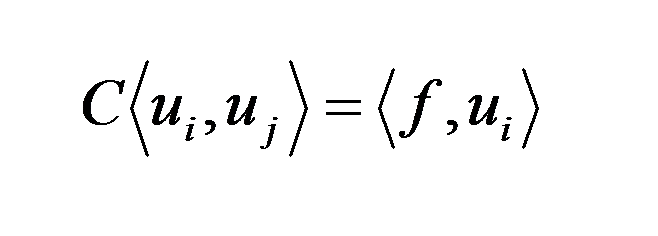
Don't panic - this is a Perfectly Normal Equation.

Many textbooks refer to these as simply the "Normal Equations," and this omission betrays the authors' ignorance regarding the real origin of the name, as well as their deplorable lack of familiarity with the works of Douglas Adams.  They assume it's because "normal" is another word for "orthogonal" meaning "perpendicular to each other."  In other words, no combination of any of the equations will adequately work as a replacement for any one of them.

While that is technically true, the real reason for the name "Perfectly Normal Equations" is so that when people see them, they will be prepared to accept these equations as "perfectly normal" and will not freak out and alert the Authorities, or do something equally dramatic and ill-advised.

The one slightly disconcerting thing about the Perfectly Normal Equations is that there appears to be only one of them.  And, they are not actually equations, but more like the pattern or formula one uses to create the specific Perfectly Normal Equations for any given situation.   The elegantly simple statement shown above is really a set of instructions for how to combine something called "Basis Functions" into Perfectly Normal Equations which will then perform all kinds of wonderful feats.

Actually, the only wonderful thing they do is cast mathematical shadows, the way a 3-dimensional object casts a 2-dimensional shadow on a wall.  But in this example, it's an object with hundreds of dimensions, and we want to "flatten" it down to just three pieces of information: the radius and two center coordinates of a circle.  But that is wonderful enough for me.  I am easily amused.

So.  What are the Basis Functions of a circle?  Whoops - they didn't teach us that in school, did they.  That is the part I had to figure out all by myself, and this is the stroke of jeenyous that leads to this amazing solution to a tricky problem.

First, what does the word "circle" really mean?  To get specific enough to be useful, we have to define it as those points on a plane that are all exactly a certain distance (called the radius) from one point (called the center).  We can use good ol' Pythagoras' formula for the distance between points.  And that is the rule or statement that defines what is a circle.


But not every circle is centered at point 0,0, and so we have to allow for the possibility that the center is located at some point (xo, yo) instead:
General Equation of a Circle

Just because I felt like trying something different, I decided to re-organize this equation to make it look like a polynomial in X and Y being equal to a function of X and Y.  The inelegant result is this:

The John S. Jacob form of the Circle Equation

And now the AHA! moment.  In that form, a circle looks exactly like something that might fit in the Perfectly Normal Equations:

If you've ever sweated through a math class, you might be experiencing some disappointment right here.  "What?  That's it? x, y and 1 are your basis functions?  That's LAME!"  Well, to be honest I expected something more complicated too.  But that's how it comes out.  Some days there's a fine line between genius and idiocy.

Now the Perfectly Normal Equations can be written out in all their salacious details.  I will spare your bandwidth here, but if you really want to see them in their exposed glory, contact me and I'll send you a pdf.

Three basis functions means there are three Perfectly Normal Equations, each containing three terms.  That forms a 3x3 grid, which itself makes a new kind of number that obeys a fancy sort of arithmetic called matrix algebra.  All we need to do is find the inverse of that matrix to solve for the three unknown constants, C. Why?  What will knowing the three C's give us?

Aha!  Another flash of genius.  The three C's are enough information to puzzle out the three exact values of  xo, yo and r.  And THAT tells us the absolute best circle that fits the entire data set.

Anyone can do this, because if you're reading this, you personally have access to about 1 million times the computing power needed to perform this calculation in less than a second. And the chances are very good that you have unknowingly already used Perfectly Normal Equations.

If you ever took a science, economics, business math or statistics class, you may have used Linear Regression to find a straight trend line that fits some data.  Did you ever stop to wonder where they first got the formula for doing Linear Regression?  No, of course you didn't.  Because you, unlike me, are Perfectly Normal.

Linear Regression is nothing more than the Perfectly Normal Equations using x and 1 as basis functions and a comparatively infantile 2x2 matrix inversion.

That's how Perfectly Normal they are!

Not to brag, but I've used the Perfectly Normal Equations and a 10x10 matrix inversion to save my former employer mega $$$ and heaps of space on a circuit board.  Talk about tough, I used up a whole pad of paper and an entire pencil working it all out.

But they were really nice about it - they bought me another one.


Exactly where did I learn all this stuff?  Oh, books, mostly.  This one by Kincaid and Cheney is a really good one:

Thursday, March 15, 2012

My Reaction (Har!) to the Nuclear Debate

I crack myself up. Seriously, though. it has been observed that there is not one major global problem that could not be significantly diminished, if not altogether eliminated, by only one minor change that is entirely within every individual's reach.  Just one simple choice could solve the problems of Global Warming, peak oil, disease, poverty, war, urban overcrowding, crime, environmental degradation, extinction of species, water shortages, the Great Pacific Garbage Patch, traffic congestion, overflowing landfills, and American Idol.

That powerful but simple solution is this one easy-to-understand idea:  fewer humans on the planet.  That isn't likely to happen any time soon, since making more humans is just so gosh darned fun.

(Keeping one's pants fully in the "on" position is coincidentally also the solution to a surprising number of non-global, personal, legal, financial and medical problems, but that's another post.)

There is no question that we are going to run out of cheap energy relatively soon.  Yet everyone I've talked to recently still seems fully committed to reproducing themselves as many times as possible.  An alternative source of energy is needed if only to provide the illusion that everything is going to be OK while we continue to breed like teenage rabbits in a carrot silo.

This is the point at which some shill from the energy company pipes up and says, "Did you know that just one tiny kilogram of environmentally-friendly non-CO2-emitting Uranium replaces about two thousand TONS of horrible, disgusting coal?  With nuclear power, you humans could continue having sex for thousands of years to come!"

This raises two vitally important questions.  1) What happens after that?  2) Are you a robot, or an alien, or an alien robot?

His answer is, "Mumble mumble mumble mumble mumble."

"WHAT WAS THAT YOU SAID?"

"I said you're right back where you started, plus you have a bunch of, um, radioactive waste to deal with.  Hey, but at least it was cheaper than solar power!"

Is it really?  Not when you include ALL the costs.  Storage of the waste in particular is a blank-check expense.  Nuclear waste  is composed of an unmanageable jumble of highly hazardous substances all mixed together.  It really isn't worth mucking around with, because it's a never-ending game of whack-a-mole.  Just when you figure out how to neutralize one radioactive isotope, it decays into several new ones.  No, with this sort of muck, there's no point mucking about.  Best just put it someplace, and then never ever go there again.

That's why the Australian Goobermint has recently taken steps towards the establishment of a permanent nuclear waste storage facility (a shed, actually).  They considered the question of where to keep all this muck, and came up with the answer:  out in the middle of nowhere at a place called (and I am NOT making this up) -  Muckaty Station.

But how much is this going to cost?  Including a couple of rent-a-cops who will stand guard and prevent terrorists from stealing the glowing deadly muck, I optimistically estimate that it will cost 5 cents per day.  I'd make it 1 cent per day to be even more optimistic, but 5 cents is the lowest you can go in Australia, they having wisely done away with all the one-cent coins years ago. (Are you reading this, America? It works, it saves lots of time and tons of federal money.)

So, how many days will the radioactive waste need to be stored?  And keep in mind that we're going to be making more of it as time goes by.  It works out to be . . . infinity days.   Now, what is our very optimistic 5 cents per day times our frankly realistic infinity days?  Whoops - this calculator doesn't go that high.


-            -             -


Until someone figures out an affordable and politically acceptable means of dealing with nuclear waste, I say that it is NOT CHEAPER than solar power or any other form of energy.  Until that problem is solved, I maintain that the actual cost of nuclear power is infinity.

Plus thorium.  I meant to work that into this post somehow.  We should be looking at thorium fuel cycles, not uranium, because you can't make weapons out of it, it's inherently stable and stops reacting when you get hit by tsunamis, and the waste is slightly less nasty.  So, there it is.  The answer to all our problems is to stop having sex, and use more thorium.

Saturday, March 10, 2012

A Complicated Day

March 10 is always a complicated day for me, for complicated and varied reasons.
For example, on this day in 1957, a man named Mohammad bin Awad bin Laden became a father.  Again.  He managed to do this a total of 54 times in his life, with 22 different wives.  See, now there's a guy who understood about putting all your eggs in one basket.  One smart man, if you ask me.  Obviously, not all your kids will turn out great, but what a disappointment little Osama turned out to be!

It's also the day  in 1940 that Ray Norris, famous Oklahoma mechanic and truck driver, became a dad for the first time when little Carlos was born.  Ray was destined for heartache however when the boys' mother moved to California, taking Ray's sons with her.  When Chuck Norris breaks someone's heart, it stays broken.

Graham Farmer, born on March 10th.
James Gerald Ray became a father on this day, as well.  In 1928.  We know so little about him, though.  Did he ever wonder, for example, where he went wrong with his son, the low-life assassin James Earl Ray?

It's not all bad news, though.  In 1935 on this day, a man named Farmer had a son nicknamed Polly.  This lad became the most famous Australian Rules Football player in history, Graham Farmer.  In America, he'd probably be the equivalent of Ronald Reagan or something.  Today, there's a freeway in Perth named after him, the Graham Farmer Freeway, which passes directly underneath the dodgy Perth suburb of Northbridge.  Good job too, because you wouldn't want to have to drive through Northbridge if you could help it.  The tunnel is known among your more humor-orientated locals as "the Polly Pipe."

Eddy Lincoln's proud papa,
shown here WITHOUT a hat.
On this day in 1846, famous beard and hat aficionado Abraham Lincoln became a father for the second time.  What a great man he was, who contributed so much to the world of public hat and beard wearing in spite of having such a miserable home life.  Even naming the child was mired in conflict:  "Eddy" versus the mother's irrational insistence on "Eddie."  What a nut-job that Mary Todd was!  But Lincoln's joy was to be short-lived.  Literally, as Eddy only lived to age three years, ten months and 21 days.  I cannot look at a  US one cent coin without seeing some of his anguish.

Also on this day, in 1947, famous Toledo resident Don Scholz became a dad!  This is wonderful news, because little Tommy did everything that typical boys do.  He fiddled with everything from go-karts to airplanes, was a basketball star in High School, took piano lessons, and went on to get a Master's Degree in Mechanical Engineering from MIT.  Don was incredibly proud of his boy Tom, but the best was yet to come.  After working as an engineer for a few years, Tom Scholz literally "gave up the day job" and founded one of the three greatest American Prog-Rock bands ever, Boston, and became a bazillionaire rock star!  Every parent's dream come true.

Founder of Boston born on 10 March.
(The other two are Kansas and The Mothers of Invention, in case you weren't sure.)

Many people misunderstand what it means when  father is "proud" of his boy.  They project their own insecurities onto the situation and assume that it is a kind of boasting, a self-validation, living vicariously, or the dad simply attempting to big-note himself for something the son has accomplished.  This is the wrong interpretation entirely.  That swelling in the chest that a father feels when his son makes good is pure joy from the knowledge that the boy has unlocked a little of his own unlimited potential and is experiencing some measure of fulfillment of his own life's purpose.  That's what every father yearns to be able to do.

On this day in 1964, a very lucky guy named Phil became a father for the fourth time.  Who exactly is this Phil person?  It's a little complicated.  His real name is Phillip von Schleswig-Holstein-Sonderburg-Glücksburg.  But he's not German as one might assume, he's actually Greek.  He married well, though, to an English gal named Elizabeth Alexandra Mary Windsor, otherwise known as Queen Elizabeth II of England!  Although the lad in question, Prince Edward, will never become king of England (I think even his Chauffeur is ahead of him in the succession line), Phil is still very, very proud of his boy Edward, Earl of Wessex.

Speaking of royalty, this is also the very date in 1845 on which Alexander Nicolaievich Romanov's life changed forever.  His son Alexander Alexandrovich Romanov born on that day succeeded him as Tsar Alexander III of Russia, but married the most unfortunately-named woman in History: Dagmar.

Karl Whilhelm Friedrich von Schlegel,
born 10 March 1772.
In 1772, on this day, Johann Adolf Schlegel became a dad for the second time.  Both his sons became important German scholars and philosophers, but the younger son born on this day was by far the shining star of the two.  Karl Wilhelm Friedrich von Schlegel achieved rock-star status among German intellectuals.  Of course today no one remembers exactly what their deal was, but at the time it was all terribly important stuff.


On this day in 1705, Johann Jakob Stöller (what an AWESOME name!) became father to a son who went on to do some tremendous things.  For example, he discovered Alaska.  No small feat, since Alaska is a frickin' huge, frozen object found way, way up there!  Young Georg Wilhelm also got a lot of animals named after himself, also as a result of discovering them.  I'm not sure how he missed out on naming rights to "Alaska" though.  So I'm going to start calling the place "Stöllerland" from now on.

March 10th was not really a wonderful day for one particular father, however. Jean Calas, a merchant from Toulouse, France, died on this date in 1762 at the hands of his torturers, fanatic Catholics (i.e. the French Government) who insisted that he had killed his own son.  In fact, the son had committed suicide, but out of shame the family tried to hide the fact, which led authorities to suspect the dad of filicide.  A terrible series of events, to be sure.  And as usual one with at least one positive outcome.  The famous French philosopher Voltaire, aka Françios-Marie Arouet, became interested in the case and through his incessant needling, haranguing and embarrassing the government, he succeeded in having the charges reversed posthumously.  He also secured a substantial payout for the bereaved and aggrieved family.  The government was thereafter a little more circumspect about torturing people to death whenever Voltaire was around.


On March 10, 1977, Astronomers announce that they have discovered a ring of debris around Uranus.

What's so funny?  It's a true fact.  Look it up.

On March 10, 1876, Alexander Graham Bell made the very first telephone call, to his assistant who it turns out was only in the next room over.  He was over-charged for the call, and is currently still on hold with customer assistance to try to get it resolved.

That means that as of today, the telephone has been around for 136 years.  But do you think my son will pick one up and call me?  Or is he going to wait another 136 years to talk to a dad who is very proud of him, no matter which nation or province he becomes supreme ruler over, how big a rock star he becomes or how many new species get named after him?

Son, you're always a star in my book.