Showing posts with label Music. Show all posts

Friday, January 10, 2014

If It Isn't Baroque, Don't Fix It.


File:Statue of J.S. Bach in Leipzig.jpg

The Shed as a retreat is extremely versatile.  For example, it has recently enabled me to run away to Leipzig in the first half of the 18th century.  That's the time and place to which JS Bach belonged.

I did not accomplish this through anything fantastical like time travel nor by anything too mundane like downloading some tracks to my mobile phone.  My escape was not mere passive consumption.  It was achieved through attempting to re-create some of Bach's music in a manner that I consider fit and proper.

Yes, I could have simply listened to the CDs again.  But to be honest, some of the re-interpretations and so-called performances of Bach's preludes and fugues make me want to - well, not quite burn my ears off with acid.  Certainly, at least, they make me want to listen to something else.

That's why I take it upon myself to arrange and produce my own recordings of Bach's most astonishing works.  In not just the history of keyboard instruments, but in all human history, the Preludes and Fugues are among Mankind's greatest achievements.

Yes, Baroque music may be considered quaint and primitive in comparison to mind-blowing experiences like Rachmaninoff or Jimi Hendrix.  But closer inspection of these pieces reveals a depth and complexity that would make any century proud to claim them.

True, Baroque music is extremely simple rhythmically.  Four evenly-spaced beats repeated, then divided equally in half, then divided equally again and again.  Nothing can be simpler, and our entire system of music notation is based on the temporal simplicity of that age.  But that simplicity is more than made up for in its harmonic complexity.  There are harmonies of harmonies, or meta-harmonies.  Bach's harmonic systems exhibit almost fractal divisibility.


But, there's no use talking about it.  Enjoy the fruits of my efforts:  the D-Major Prelude and Fugue, BWV 532.  Being in a major key, it's relatively up-beat and cheerful.  But not so much as to forget one's dignity.


So sit back, put on headphones, and leave the 21st Century for the next 10 minutes and 34 seconds.

Monday, September 9, 2013

New Music for your Dancing and Dining Pleasure

I thought I'd give Audacity another try.  The last time I tried it was about five years ago, and the sound quality was hopeless.  The laptop I was using at the time may have had something to do with it, but recordings using other software on the same machine sounded much better.

This time the sound is pretty good, if you can overcome the latency problems that cause tracks to be shifted out of sync with each other.  I've decided to blame all the problems and mistakes in these two numbers on that issue.  However, once again the hardware has a lot to do with it.

On my older XP machine I could play the keyboard instrument straight through the soundcard and out the speakers.  With this newer, larger and more expensive computer running Win7, the latency is so bad that I cannot even play a few notes: the delay between playing a note and hearing the note drove me bonkers.  The issue was so bad that I bought a second pair of speakers just to avoid ever experiencing it again.  When I play the Nord (which being a stage performance instrument has no built-in speakers) into the computer, I must disable the computer speakers and monitor myself through the second pair.

And so, when Audacity is playing and recording at the same time, the resulting tracks are so far out of sync it sounds like there are two different songs playing over each other.  I had to manually, meticulously nudge them back and forth until they matched.  Of course that was impossible, because my playing never matches from one track to the next, so the best a mathematically-minded musician can to is to minimize the error in the least-squares sense.

Or just keep fiddling with it until it sounds OK.  Yeah, that's actually easier.  It helped to magnify the waveforms and line them up visually.


In any case, the first song takes advantage of the fantastic backing accompaniment available on the Roland FP-80 instrument.  The three piano parts you can hear are me in live performance.  Just not performed all at the same time.

This is a Gospel-style blues that makes abundant use of 6, 9 and 11 chords.


The second, conceived and recorded all about a half an hour after finishing the previous track, was meant to be a showcase for the amazing and deeply satisfying Nord electric stage piano sounds that I have been enjoying privately for some months now.  There are three piano parts, no drum or backing track, and it's all me.

I've known since about 1986 that simply dashing off a musical number and committing it to a recording in multiple tracks is not as easy as it sounds, particularly when it's being improvised on the spur of the moment.  And if your sense of rhythm and tempo are as abysmal as mine.  Virtually non-existent.  Plus, each time you rewind and lay on another track, you have to remember exactly what you did previously and when exactly you did it.

I didn't accomplish that perfectly this time, but I really enjoyed giving it a go!


Let me know what you think.


Sunday, June 30, 2013

Keyboards, keyboards

As a wee lad I had little interest in music.  I attribute this to the cognitive dissonance between what was defined to be music in my parents' home and my internal experience seeking expression.  I just didn't feel inside the way classical music, least of all opera, sounded.

My interest in music was born the day I heard Blues for the first time.  Prickles on the back of my neck.  Now that's what I'm TALKIN about!  That's MUSIC!  That's MY music.

At around 22 years of age the need to actually make Blues music was growing impatiently.  So I bought my first keyboard.  It looked exactly like this:


Mom's piano, a Baldwin
Acrosonic, still in the family
and still being played.
Really.  No joke. Obviously, there was already a piano in my parents home and always had been: a very competent Acrosonic console from the early 1950's, my mother's personal piano that she owned since she was about 11.  (I later learned that she was an accomplished classical pianist, but I did not know this at the time.)  So why did I need this tiny Radio Shack novelty?  Well, I couldn't be seen and especially heard to be laboriously practicing the piano, so a tiny, plastic, portable, electronic gadget that I could play through Walkman-style headphones was just the thing.

And play it I did.  Unbelievably, on that ridiculous toy I learned all the major and minor scales, practicing them endlessly.  I learned jazz scales, and most importantly, the blues scales.  I learned a few songs, too. I also learned that the piano wasn't beyond me, and this tentative step, this dipping of the toe so to speak, was rapidly superseded.

My next keyboard, purchased second-hand a short time later, was the legendary Casio CZ-1000 phase-distortion synthesizer.  Yep, it even has its own Wikipedia page!


I had a lot of fun with this and a 4-track cassette recorder.  The sounds were primitive by today's standards, but it sounded great at the time.  It was also fun to fiddle around with the oscillators and create new sounds.  Years later I gave this keyboard to a family I thought could really use it.

In the mean time, I was hungry for more, and the big thing in the 1980's was Polyphony.  How many notes could an electronic instrument produce at the same time?   My first tiny toy keyboard had a polyphony of one (is that monophony?) The CZ-1000 had a polyphony of 4 or 8, depending on how many oscillators were needed to produce the tone.  So I could actually learn chords now.

But I wanted to use the new MIDI standard and play ALL the music!  So I needed this:


The Roland D-10 multi-timbral workstation.  It was 32-note polyphonic, and 16 of those could even be completely different sounds!  This was the first Orchestra in a Box.  I had some great times with this, including the following completely digitally-sequenced track I produced using this machine in 1989:


(Bach's Prelude and Fugue in Am BWV 543)

and this performed by me, aptly titled, "Don't Laugh,"


My first real piano, bought very second-hand in about 1998 for $200, was not so much a piano as it was a sort of piano-shaped box of assorted piano parts.  It was really more of a piano kit.  I spent two years building a piano out of it.  It was an English birdcage action upright, and had one hell of a big sound when I got done with it.


When I moved to Australia in about 2000, I was keyboardless.  I had a harmonica, that was all.  It took about 8 months before conditions were ripe for me to have a piano.  This is what I bought, for about $2500:


When things went non-linear a few years later, I would again be without an instrument (not to mention a home, a family, friends, a job, a sense of identity . . . .)  But the keyboard situation was ONE problem I could do something about.  I went to the music shop, said, "I'd like a portable digital piano, please.  That one, there."  The sales clerk blinked twice, collected what wits were at his disposal, and said, "um, OK!"  It was a Casio Privia Px-300.  All in all, a good machine.

But playing at home and getting up on stage to perform are two very different things.  I realized after the Bridgetown Blues Festival last year that I was at a serious disadvantage, but one that could be addressed.  Specifically, I needed the Nord Electro 3/73 professional instrument.

And, lo, I beheld that it was good.


Update:  August 2013.  I have acquired possibly the most advanced digital piano in the world, and possibly the first one in Western Australia.  It's the Roland FP-80, featuring an advanced piano engine that models the hammers, dampers, strings and even the cabinet of a concert grand.  Its simulated ivory key tops look, feel adsorb and respond like real ivory, and the internal hammer action gives keys the right amount of inertia for a genuine playing experience.  Do I sound a bit like an advertisement?  That's because I'm in love with this instrument!

Except for one small thing:  There seems to be a housing/case resonance right on A3.  It disappears when I use the headphones or play through external speakers.  I'll be asking Roland for a tech note on that problem.  Meanwhile, let's enjoy it:


Sunday, June 9, 2013

Another Perfect Day For The Blues

I get these a lot for some reason.  The sort of day no goddamned good for anything except playing the blues.

I call this the Sunnyland Blues because it takes certain liberties with the 12-bar Blues Form.  But it does so with authority, specifically that of Sunnyland Slim who used it to great effect.

In a 12-bar in A, one normally hears only A, D and E.  Listen carefully for the odd F and B that sneaks in there.


Thursday, May 9, 2013

I Had A Spider In My Hair

It had to happen eventually.  This is Australia, after all.

It must have dropped onto me while I was pruning some trees.

What did I do?  The only sensible thing that could be done.


I wrote a song about it.


I had a spider in my hair.
A real-live spider crawling in my hair.
It was awful
but not the worst thing I've been through.

I had a tick once, in my navel.
A big fat tick right in my navel.
It was really gross
but not the worst thing I've been through.

You let a centipede loose in our tent.
A real live centipede was in our tent
while we were camping that one time.
Boy, we sure got out of there in a hurry.

You moved away and never came back.
Far away, and never call or write.
For any dad who's been through that
who cares about some little tiny spider in his hair?

I used to be afraid of being eaten by sharks.
I used to worry about drowning at sea.
When the worst thing has already happened
Even dying doesn't matter to me.


© 2013 John S. Jacob

Sunday, December 2, 2012

A Typical, Ordinary Saturday at My House

Honest, folks, this really is what a normal Saturday is like at my house.


The innovative Nord Electro 3, 73-Key Electronic Stage Piano and Organ reproduces the great keyboard instruments of the 20th century. In this case, a Wurlitzer Stage Piano with added a-wah effect and just a touch of overdrive. I'm using the low-noise 50-W amp I built a few years ago, which produces a very clean facsimile of the input without adding or removing anything.


Monday, November 12, 2012

I got those Bridgetown Blues

There's a sleepy logging town buried in the forests of southwest Western Australia.  You would probably not take much notice of it if you were passing through on your way to somewhere else.

But on one weekend each November, its population explodes from 2970 to over 15,000 as fans and musicians descend on the town from all over the globe for a three-day party.  You would certainly notice Bridgetown then.  There is no "just passing through," because Bridgetown IS the destination.

Besides, they block off the main road.

Friday night at The Blue Owl, a 1000-man tent full of Blues.  Charlie
Musselwhite performing.

This year is the 20th anniversary of the Blues at Bridgetown music festival, and the first year I've been able to attend in spite of A) being a dyed-in-the-wool lifelong Blues addict, and B) living just 3 hours away from Bridgetown for the last dozen years. But this year I finally answered the call.

Literally.  The phone rang Tuesday morning, four days before the event.  My best mate Tim had the news that the West Coast Blues Club had been given a 50-minute slot at one of the five venues on Saturday night, but that their house band had flaked out for one reason or another and couldn't make it.

The club president had asked Tim to put something together.

The gig was unpaid, but the free admission to all areas of the festival was worth $186.  All we had to do was get there.  Oh, and find a bassist and drummer too.  This turned out to be harder than it sounds.

But Tim was persistent and resourceful, and after phoning nearly everyone he had ever played with, managed to put together an amazing lineup of musicians, meeting the following high standards of qualifications:

  1. They have their own instruments and transportation.
  2. They are free during the scheduled performance.
  3. The credible prospect of Public Humiliation does not faze them.
Using these exacting criteria we put together a band that played for the first time together on stage in public at the Bridgetown Blues festival.  No rehearsals, no practice, no warm-up.

Sometimes the light's all shining on me.

You'll have to take my word for it that it came off incredibly well, all things considered.  Because finding someone to take some video was one thing we were regrettably unable to pull off at the last minute.  But it might have been something like this plus bass and drums, and on an outdoor stage in the rain.  Use your imagination.

Tim, drummer Aki and I on stage at the Green Room musicians club.

But that was just one of the amazing experiences we had.  The rest of the weekend was spent weaving through crowds from one stage to another, checking out as many acts as we could, availing ourselves of the services of food vendors when absolutely necessary, jamming with local musicians at The Green Room, and then taking a quick kip in the backs of our utes off the side of a deserted road when caffeine could no longer postpone sleep.

The Utes: our mobile motels, storage facilities, dining halls, research
centres, and rehearsal studios.


But all good things come to an end, including my supply of Dr Pepper, and so it's back to the real world on Monday.  

             ____


Here's a list of some of the amazing performers I had the chance to see and hear:

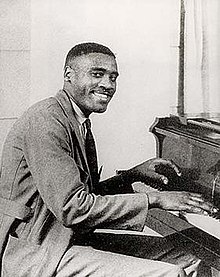
Scottie Miller - a piano player from that historic incubator of the Blues on the Mississippi: Minneapolis, Minnesota.  Also a protege of my great piano heroes: Dr John, Prof. Longhair, and the great James Booker.

Minnie Marks
Minnie Marks - looks like a teenage girl, plays bottleneck like Robert Johnson and Eric Clapton's love child after forty cups of coffee, if that were even biologically possible ('cause you'd probably be dead after that much coffee).  This complete mismatch between appearance and sound absolutely blew the lid off the largest venue at Bridgetown.  I saw hairy tattooed biker dudes jumping, clapping and screaming like little girls at a Justin Bieber concert.

Mia Dyson - Janice Joplin meets Joan Jett meets Concrete Blonde in this Melbourne-born rocker now working LA. Miss this act and Mia will personally and deservedly punch you in the face.  

Dream Boogie - an Australian act fronted by a luxuriously seductive Mississippi Bayou Queen complete with feather headdress and sleeveless sequined gown, and backed by a solid blues trio with an authentic sound.  An unforgettable live experience.

Ali Penney - a piano-playing barmaid from Sydney takes it on the road with a powerful Blues act.  BONUS:  Her bassist Hans Deberitz played on stage with Tim and me!!! How cool is THAT???

Mojo Webb - a hot blues frontman with talent coming out his ears.  It started raining during his performance at the Geegelup open-air venue, but I could not turn away.  By the end of the set, I was soaked to the skin.  No matter, though.  Rain comes and goes, but Blues are for life. 


Monday, March 26, 2012

Listening In with AWSMCBB

Lets listen in on a practice set with the All White Suburban Middle Class Blues Band.

Motto:  "We Play The Blues 'Cause We Paid Our Dues (and we got a tax receipt of course.)"


First up is an old original Fleetwood Mac number, "Heart Beats Like a Hammer" from their debut album imaginatively titled, "Fleetwood Mac."  This goes back to the days when Fleetwood Mac was still strictly a Blues Band, before the girls came to play.


(If there is a problem with playback, click "pause" for a few seconds and allow it to buffer.)


Next we have a go at Otis Rush's "All Your Love" which has also been covered by the likes of John Mayall and The Bluesbreakers (featuring Eric Clapton), Aerosmith, Stevie Ray Vaughan, The Steve Miller Band, and now of course The AWSMCBB. That's us.


Finally, one of our old standbys, "Tore Down" by the ineffable T-Bone Walker (aka Aaron Thibeaux Walker, 1910 - 1975). What does 'ineffable' mean? I assume it means "not able to be effed." So we'll do our best not to, this time.


The AWSMCBB is:

Tim (guitar & vocals)
Nick (bass)
Paul (drums) and
John (piano & organ).

Our music is NOT SOLD IN ANY STORES!   Gee, I wonder why.

Tuesday, January 17, 2012

Another Amazing Date on the Calendar

How do we even manage?  We've just recovered from the Christmas and New Years double-onslaught of festivity-ness, when this date sneaks up on us.  January 19th, one of the most awesome days of the year!  What, you haven't heard of it?  Allow me to elaborate.

On this blog I would normally drone on endlessly about this being the birthday of people like James Watt (1736), the Scottish inventor who made crucial improvements to some sort of engine and got a unit of power (1 Joule per second) named after himself, or Sir Henry Bessemer (1813) who invented a vitally important process for making steel in mass quantities (before that, steel was nearly as precious as gold).  But these aren't the reasons this day is special to me.

General Lee.  What?  Is there some
other General Lee?
Those observations would overshadow such momentous events as the birthday in 1807 of General Robert E. Lee.  And the birthday in 1939 of Phil Everly of The Everly Brothers, the most popular country-rock pair of all times with a world-record 35 Top-100 singles, more than any other duo in history.

Of course where would Country Music be with out the birth on this day in 1946 of Dolly Parton?  She's only the most successful female Country and Western artist of all times, and for obvious reasons.  Although there have been no confirmed sightings of the elusive Ms. Parton since 1987, locals report seeing a large pair of bosoms occasionally entering or leaving the Parton compound.  We can only assume that she is under there somewhere.

Ms. Parton is presumed to be in there,
somewhere.  There's no way to be sure.
It's also the birthday of Rock legends Robert Palmer ("Addicted to Love"), Rod Evans ("Hush"), and Jeff Pilson (bassist for Foreigner and Dokken).

One of the great mysteries of the universe occurred on the 19th of January in 1943: the simultaneous birth in Canada of Princess Margriet of The Netherlands (which itself is kind of a mystery), and that of Janice Joplin in Port Arthur, Texas.   Joplin is ranked by Rolling Stone magazine as the 46th greatest performer of all times.  That feat was accomplished in only a four-year singing career, ending with Janice's death at age 27.  Queen Beatrix probably wonders where she went so wrong with Margriet, who isn't even in the Top 10,000 performers of any given minute, let alone of all times.  I mean, practically nobody has even heard of her, and she's lived way, way longer than Janice, too.  According to the astrologers, she should "in theory" be able to sing exactly like this:


January 19th is believed to be the day in 1938 that General Motors commenced mass production of its first Diesel engine.  Fifty-two years earlier on this date in 1886, the first skiing club in the US was formed in Minnesota. And in 1903 on this day the announcement was made of a new annual bicycle racing event in which the riders would pretty much make a complete tour of France.  They never have been able to come up with a catchy name for it, so to this day they still just call it the Tour of France.
Diesel = Good.

On this day in 1981, the unfortunately-named Beat Moor applied for a patent on an improved grip for ski poles. Exactly one year later in 1982, patent no. 4311321 was issued for a new kind of electronically-controlled ski binding release mechanism, and in 1995, a world patent by two Germans was published for a new kind of ski boot for some reason.  Inventors have been quite busy, blaming their lack of skiing ability on inadequate equipment, when we know that really they're just a bunch of uncoordinated nerds.

But on this day, January 19th in 1912, a patent with the unlikely number 1,111,999 was executed on behalf of some nerd named Thomas Alva Edison for a "Phonograph Record."  And on January 19, 1934 at Abbey Road Studio in London, the first ever stereo recording was made that utilized a single stylus vibrating in two directions, thus encoding the right and left channels separately in the same groove.  Also on this date in 1988, a patent was issued for a new kind of electric guitar.  But don't get too excited: it's pretty much a normal guitar, only in the shape of a fighter jet.  No need to throw out all your old ones just yet.

With all these awesome things happening on the same date, it can hardly come as any surprise at all that January 19th would be the birthday of a most unique individual, an incredible skier, mountain biker and outdoorsman, a fantastic husband and father of three amazing kids, an immensely talented photographer, music video producer, musician, composer, arranger and recording engineer, and above all, an excellent driver.  Happy Birthday, my friend.  You know who you are.  I don't doubt that someday everyone else will, too.

Sunday, January 15, 2012

Here Come Those Blues Again

My appreciations goes out to Mike Stone for a fantastic couple of sets at his house Saturday.  Thanks to his wife Lynn for the hospitality, to the very talented George for the rock solid and amazingly groovy beats, and all the guys including Harry (guitar & vocals), Malcolm (bass), Jeremy (guitar), and the sax player who lives such a fascinating double-life, it is actually a felony for me to disclose his name.  (OK, the truth is I forgot his name.  Are you happy?)


This of course is a rendition of T-Bone Walker's T-Bone Shuffle.  What, you weren't expecting the Porterhouse Shuffle, were you?  The Filet Mignon Shuffle?  For that I'm afraid you've come to the wrong blog.


And finally, from one of the greatest blues artists living or dead, BB King's The Thrill Is Gone:


.

Tuesday, December 6, 2011

More Secret Men's Business

Walt Whitman wrote:

A batter'd, wreck'd old man,
  Thrown on this savage shore, far, far from home,
  Pent by the sea and dark rebellious brows, twelve dreary months,
  Sore, stiff with many toils, sicken'd and nigh to death,
  I take my way along the island's edge,
  Venting a heavy heart.

  I am too full of woe!
  Haply I may not live another day;
  I cannot rest O God, I cannot eat or drink or sleep,
  Till I put forth myself, my prayer, once more to Thee,
  Breathe, bathe myself once more in Thee, commune with Thee,
  Report myself once more to Thee.
...

My hands, my limbs grow nerveless,
  My brain feels rack'd, bewilder'd,
  Let the old timbers part, I will not part,
  I will cling fast to Thee, O God, though the waves buffet me,
  Thee, Thee at least I know.

  Is it the prophet's thought I speak, or am I raving?
  What do I know of life? what of myself?
  I know not even my own work past or present,
  Dim ever-shifting guesses of it spread before me,
  Of newer better worlds, their mighty parturition,
  Mocking, perplexing me.

  And these things I see suddenly, what mean they?
  As if some miracle, some hand divine unseal'd my eyes,
  Shadowy vast shapes smile through the air and sky,
  And on the distant waves sail countless ships,
  And anthems in new tongues I hear saluting me.


Our old friend Walter raises several very good points with this.  One concerns the Mathematician, aka the Magician.  The doer of magic, so-called, because so few understand it.  So few also comprehend the effort it takes, the years of preparation and study, enduring confusion, suffering privation with a single purpose in mind:  to Know.  Nor do they see the power that must be summoned to create such original works. 

At some point the Magician must bid goodbye to his powers and see his works blossom or not, float or sink as they will, without him to steer them.

Another is the Grieving Man, so full of woe and venting a heavy heart.  Where does he come from?  Where does he go when at last he disappears?  To quote the great Leroy Carr, "The blues, they come, the blues they come, nobody knows where the blues come from; the blues they go, the blues they go, and everybody's happy when the old blues go."*  It must serve some divine purpose, as everything in existence (which existence is the divine itself) must do.  The clever part is in finding it out.

One final word, and if this isn't making sense, then check the title again.  Things can be hidden in plain sight, like the Parables. What I'm really interested in knowing is this:

Why is there new hair growing on my ears that  was never there before?  What possible benefit could that bestow upon me?

Am I turning into some sort of Hobbit?


* Leroy Carr (1905-1935) was a blues pianist who lived only to age 30 but within that short time influenced generations of artists including Nat King Cole, Ray Charles, Count Basie, and T-Bone Walker.  The lyrics come from the song "Papa's on the housetop."

And would you LOOK at the size of those hands?


Monday, November 28, 2011

Ramblin' on my Mind

Tim and I were invited to play at a private party last Saturday.  We only had once chance to practice beforehand.  The results are as follows:


We're looking for a drummer and bassist to play with us once in a while.  But so far we haven't found any who, like us, are unable to keep a tempo.  It just wouldn't work.


The real thing:

Tuesday, November 8, 2011

A Very Auspicious Day - November 8

You might not be aware that November 8 is one of the most interesting dates on the entire calendar.  

For example, on this day in 1889, Montana became the 41st State of the Union.  Where would we be today if that hadn't happened?  Not in Montana, that's for certain.


X-Rays:  Creepy!
Röntgen: Creepy.
Also on this day, in 1895, Wilhelm Conrad Röntgen discovered X-Rays while messing around with electricity, thus creating a whole new way for scientists to be creepy.  And proving once and for all that messing around with electricity is, on the whole, an excellent thing to do.


Speaking of creepy, November 8 is also famous for being the day in 1923 on which a confused young Adolf Hitler attempted to seize control of Germany by occupying a beer hall in Munich at gunpoint.  And it just might have worked, if it hadn't been a completely idiotic idea!!!!  Sure, Germans like beer, but there is so much more to Germany than that.  Young Adolf wouldn't have necessarily understood such nuances of German culture, he himself being Austrian. And part Jewish.  And his real name wasn't Hitler, but Schickelgrüber.  Yes, he was a very confused young man, about a great many things.

But young Adolf learned his lesson, and after being released from prison he gave up trying to put his nefarious plans and half-baked sociological theories into effect by force.  Instead, he did what everyone else does who lusts for power, and got himself elected democratically.

Which is why you must never vote for anyone who says, "Vote for ME."  Because that person will absolutely, definitely be the next Hitler.

LOSER of the 1960 US Presidential Election
Speaking of villains and democracy, November 8 also marks the day in 1960 when Richard Milhous Nixon, the world's second most famous Quaker after the guy on the Oatmeal box, was defeated in his bid to become the 35th POTUS.  The voice of the People was clear and decisive in their rejection of Nixon as their 35th president.  Nixon accepted this decision with good grace and resigned himself to becoming 37th president instead.

Remember that word, Dick.  "Resign." It might come in handy again.

Speaking of resigning, today is the day in 2006 that the Worst Secretary of State Ever, Donald Rumsfeld, resigned.

While November 8 has seen its share of blood, such as the historic first-ever jet-on-jet aircraft dogfight (1950, USA 2, North Korea 0), or in 1520 when Denmark invaded Sweden for some reason, it has also been a day of peace.  1965, for example, when Britain officially abolished the death penalty.  Or the signing of the Pacification of Ghent in 1576.  And thank goodness for THAT.  Just imagine what your life would be like if the Dutch town of Ghent were still full of angry Spaniards.

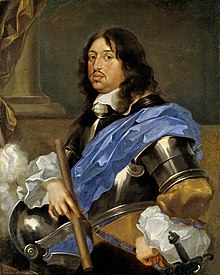
King Charles the Clueless
November 8th is also the birthday in 1622 of King Charles the 10th of Sweden, who spent most of his time trying to explain to the rest of the world that Sweden and Denmark are actually two completely different countries.  By far the most interesting thing about him is that he was actually King Charles the 4th.  But King Charles the 9th who was really King Charles the 3rd had chosen his number based on a book he read which he thought was a history of Sweden but which turned out to be a work of fiction.  Thank goodness no democratically-elected leader in modern times would ever rely on fictional stories to make important decisions (ahem).  The fact that George W. Bush had never read an entire book might actually have been for the best.


It is the birthday in 1836 of Milton Bradley, a wealthy Capitalist and entrepreneur who built a monopoly based on board games, which ironically did not include Monopoly!  Instead, Monopoly was the creation of a puritanical do-gooder who wanted to teach people about the evils and moral bankruptcy of Capitalism.  The game failed miserably in this goal, and instead became the means of introducing millions of children to the endless joys and wonders of Capitalism.  As a consequence, and much to her dismay, the self-righteous do-gooder became a fabulously wealthy Capitalist.

Also born on this day, in 1848, is Gottlob Frege, the German mathematician and logician who elevated Logic from something akin to the disreputable morass of Grecian rhetoric into a respectable branch of mathematics.  Presumably he did this in an effort to figure out what on earth his parents were thinking.  Next time you use an IF( ) function in Excel or draw a Chance card in Monopoly, thank Gottlob Frege.

Jack Kilby, Inventor of the
Calculator and the
Integrated Circuit.
One individual indebted to Gottlob Frege was the inventor of the integrated circuit, an item that makes prodigious use of Frege's formal mathematical logic.  Jack Kilby built and patented the first integrated circuit while working for Texas Instruments in 1958, and was promptly awarded the Nobel Prize.  Well, relatively promptly.  It apparently took 42 years for the news to reach Sweden.  (All their mail was being delivered to Denmark by accident.)  In any case, Jack's birthday could only be - you guessed it - November 8th!

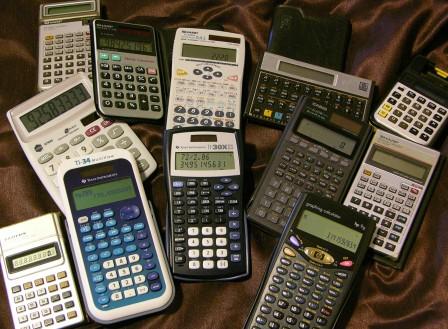
Jack Kilby was an engineer after my own heart.  He also invented the electronic calculator, which I regard as the greatest invention of all times.  If I could put just one item into a time machine and send it to my personal hero Galileo (who famously never did anything on November 8th if he could help it), it would be a solar-powered scientific calculator.  He really could have used one.  And I have a few extra, including the Texas Instruments TI-30X IIs, which in my studied opinion is the best calculator available today and a direct descendant of Jack Kilby's creation.

Some of the calculators I have owned and used.  Best Invention Ever.


Atlas: Not Verified
This day is also the birthday in 1656 of astronomer Edmund Halley, who correctly guessed the periodicity of the object now known as Halley's Comet.   It is also the day before the birthday of astronomer and author Carl Sagan.  Twelve hundred years or so from now, November 8th will be celebrated by "millions and millions" of people throughout the inhabited Galaxy as Sagan-mas Eve.

Also in Astronomy, it is alleged to be the anniversary of the discovery in 1980 of a 15th moon of Saturn based on images taken by Voyager 1 (there are now at least 62 known moons of Saturn).  Try as I may I have not been able to verify this claim, nor verify that the fried-egg-like Atlas was that lucky moon.  Actually, this factoid is almost certainly wrong.  But if it were true, how awesome would that be?
2005 YU55.  Verified.

Verified, however, is the hair-raising near-miss of a 400-meter-wide asteroid, named 2005 YU55 for some reason, passing between the earth and moon on November 8 of 2011. Hey - that's TODAY!!!

If an object of that size were to collide with the earth, it's pretty much lights out for 90% of higher life forms on this planet, and even some politicians too.  The chances that it will do so are zero, however.  Its trajectory has been very accurately plotted, and it will definitely miss us.  We'll be able to get a much better photo of it, though, so that's a bonus.

Bram Stoker's character
scares the hell out of me.
Shouldn't we really call this a near-hit instead of a near-miss?


It is the birthday of scary Irish author Bram Stoker (1874), and notable user of language Gordon Ramsay (1966).  It is the day English poet John Milton regained paradise in 1674.


November 8 is the day in 1983 that the amazing James Booker left us for the sunny side of the street.  In honor of His Magnificence, please take a moment to listen to one of the great human achievements of all time:


So my friends, enjoy this absolutely amazing, one-of-a-kind day!  What will I be doing on this most auspicious occasion?  I am going to celebrate by laying in a hammock.


.

Monday, October 17, 2011

Feelin' Blue

I've been feeling mighty blue lately.  The only cure for that is to get together with some mates and play the Blues, loud and fast.

Fortuitously, a local Blues club had "organized" (and I use the term loosely) a jam night at the Medina pub for Saturday night, Oct 15.  Medina is a suburb about half an hours' drive south of the city, and like many such places half an hour from a major city, it is the sort of place best seen after sundown.

My mate Tim and I got together the day prior for a practice session, a sneak peak of which is provided below. We hadn't played together for perhaps a year, or six months at least.  Blues musicians don't keep very good records of those sort of things.   In any case, it had been a long time and we spent two or three hours (see - it was only last week and already the basic facts are becoming blurred) to find each other's tempo and groove.

The following evening we converged on Medina only to find that the pub was dark and locked up.  Closed.  No cars in the parking lot.  The place was empty and deserted.

ON A SATURDAY NIGHT!!!!

What the hell kind of pub is closed on a Saturday night?  The Medina pub, for one. It seems that the Disorganizers of the blues jam had decided to quit and not to tell everybody.  It wasn't hard to spot Tim driving around looking for the place.  His was nearly the only other car on the road.  We made a couple of extremely indignant phone calls and left a polite but sternly worded message on the "organizers" voicemail.

Then we called it a night.  Perhaps one day we'll organize our own Blues jamming club, one that will be renown for its dependability.  It could be the first ever of its kind.


Thursday, August 18, 2011

Believe in the Day

I have always been stirred by the following poem.  Not every day is one that I feel I can readily believe in, so it's good to be reminded that every day holds promise, power, hope, life and majesty.  Vast, incredible, expansive majesty from horizon to horizon.  If the day seems small or pointless to you, then get out, get up a mountain and have a look for yourself at how limitless and grand this day really is.

The poet and the wise man stand behind the gun,
Behind the gun!

And signal for the crack of dawn: Light the Sun,
Light The Sun!

Do you believe in the day? Do you?
Believe in the day!

The Dawn Creation of the Kings has begun,
Has Begun!

Soft Venus, lonely maiden, brings the Ageless One,
The Ageless One.

Do you believe in the day? Do you?
Believe in the day!

The fading hero has returned to the night,
To the night.

And fully pregnant with the day,
wise men endorse the poet's sight.

Do you believe in the day? Do you?
Believe in the day!


Can you name the poet and the title of the work?  Scroll down.

And for you astronomers out there, you really should be able to give the identity of the lonely maiden, The Ageless One, and the fading Hero.  (Hint: the lonely maiden is a giveaway.  The name of the celestial body represented is mentioned right in the poem.  Hint:  So is the name of The Ageless One, but it's slightly less obvious.)


Give up?  This is an excerpt from a much longer poem by 8-year old child prodigy Gerald Bostock, deservedly nicknamed "Little Milton," a student at Moordale Primary School in St. Cleve, England. Having once dragged myself all the way through Milton's "Paradise Lost" I can attest to Little Milton's stylistic similarity to the master, which in some ways eclipses the blind elder Milton's genius for charged allusion to natural imagry.

Gerald's mental stability is reputed to be questionable, for reasons not the least of which is the fact that Gerald is actually a fictional character (don't laugh - it could happen to you!) He is the literary creation of world-famous flautist Ian Anderson. Gerald's lengthy poem economically forms the libretto of one of Anderson's most ground-breaking musical compositions. The 44-minute piece, much of it in 5/4 time, titled "Thick as a Brick" was first recorded as a Pythonesque prank in 1972 by Anderson's progressive ensemble, Jethro Tull. ("Call that a prog rock concept album, do they? They wouldn't know one if it bit 'em in the arse.  I'll give 'em a concept album....")

The passage I quote occurs roughly 29 minutes into the piece where it occupies a tense and leisurely 6 minute interlude. Nothing I can say will prepare you for the full impact of listening to it.  It's somewhat like the feeling of being on a wonderful, relaxing vacation and facing a return to your job in the midst of a firestorm at work.  Can you really relax knowing what's coming?


Some Interesting facts about Ian Anderson:

He holds an honorary (though well-deserved in my opinion)  Doctorate in Literature (they don't just hand those out on the street, you know), but NOT a driver's license (which virtually anyone with a pulse can get).

Anderson bought his first flute and tried out it for the first time in 1967. Within just 6 months his flute playing was an international commercial success, including a top-10 album in the UK, winning over audiences who previously never showed much interest in the flute as a popular rock instrument.  This is a great album, by the way.

He taught himself to play flute, and only discovered he was doing it "wrong" 25 years later when his daughter took formal flute lessons in 1992.  (Can you imagine the pressure?  On both the student and the teacher.) By then of course he had already made millions playing the flute and was world-famous for it. Can that really be considered "doing it wrong?"


I wonder.


My favorite Ian Anderson Quote:

Upon winning a 1989 Grammy award for, of all things, Best Heavy Metal Performance, Ian said,

"Well, we do sometimes play our mandolins very loudly."


When you think about it, flutes are made mostly of silver alloy, which technically is a heavy metal.


Thick As a Brick    Thick As A Brick (Edit No 1) (2001 Digital Remaster)  Jethro Tull: A History of the Band, 1968-2001


PS  The fading Hero of the night is of course the planet Mars, the Warrior, who for all his endless conquering never gets what he really wants.