Showing posts with label Astronomy. Show all posts

Sunday, December 11, 2011

Just An Ordinary, Boring Weekend in Oz

Some people think Perth is a boring place.  At first, I didn't understand what they were talking about.  But after getting to know Perth and learning some of the many incredibly, amazingly boring things about it, I'm beginning to understand.

An uninvited swan.
Take this weekend, for instance.  Saturday afternoon Yvonne and I were at Point Walter (what a BORING name!) sitting on the grass enjoying a meal of beef Teriyaki and Thai green curry (ho-hum - such ordinary, everyday boring food) when to our utter boredom an absolutely boring Black Swan (Cygnus atratus) casually strolled right through the middle of the picnic area.  Two hundred years ago that would have caused tremendous excitement, since at the time the mythical Black Swan was believed to be, well,  mythical.  But today if you live in boring old Perth tripping over Black Swans everywhere you go, they just contribute to the overall boredom.

Cygnus atratus,  NOT mythical.  Quite boring, actually.
Not even venomous or anything.
Later that evening, we were down at Fremantle Harbour watching the boring container ships being unloaded, which they do here 24 hours a day 7 days a week.  Yawn!  Over 26 million tons of remarkably dull goods pass through this port every year.  Then the dullest thing imaginable happened:  a transport ship from Kobe opened its hull and a bunch of ordinary Toyota cars started driving right out onto the dock.  About twenty wharfies then spent hour after boring hour parking hundreds of cars in a massively boring lot and then stuffing themselves into an ordinary minivan, driving back onto the transport ship and starting all over again.  This went on for hours.

On the bridge of HMAS Choules, facing aft, port side.
We know, because we watched the whole thing happening from the bridge of the soon-to-be-commissioned Navy transport HMAS Choules, a Bay-class landing ship dock purchased (in typical Australian fashion) second-hand on Ebay.  Ha ha!  No - they actually bought it from the Brits.  Second hand.

Well, at least they didn't pick it up on the side of the road somewhere or make off with it in the middle of the night while its owners were sleeping, which is even more typically the Australian way of procuring things.

This ship is so immensely boring that the sheer size of it stunned me into submissive silence.  It weighs 16,000 tons and is 580 feet long.  It has an enormously boring cavity right down the middle of it with enough space for 150 trucks.  That's a lot of trucks.

HMAS Choules in Falmouth drydock,
earlier this year.
To get an idea of what this experience was like, you should go out and find a parking lot big enough for 150 trucks and imagine putting the entire parking lot INSIDE the middle of a ship.  How does that make you feel?  Pretty darn bored, right?

Our fully authorized incursion onto the ship was courtesy of a friend who is an electronics technician in the Australian Navy.  He had just arrived on this ship all the way from Falmouth, England (Britain's deepest and most boring natural port) where the ship had been undergoing re-fit since August.  By the time they finally got to Perth, the entire crew was absurdly, ridiculously bored.  Perth has that effect on people.

The HMAS Choules was re-named for Australia's oldest living WWI and WWII veteran Claude Choules, who ironically died earlier this year in Perth (undoubtedly from boredom) at age 110.  He was Australia's oldest living man at the time of his death.  And he holds the World's Record for being the oldest first-time published author when he released his memoirs at age 108. This is probably how he got a ship named after him.  Well, that and his service in two world wars and 41 years as an enlisted man and NCO in the Australian Navy, of course.
December 10, 2011 Total Lunar Eclipse at about
40 minutes before full occlusion.  Photo by
 Cpl. Marek Bubna-Litic, R.A.N.,
taken from onboard the HMAS Choules.

From our towering vantage point some 100 feet above Fremantle harbor, we could see every boring thing that was going on. In particular, the TOTAL LUNAR ECLIPSE that was happening that very night right before our eyes.  This is a scientific event that is so boring it happens only every couple of years (but twice this year, being a particularly boring year).

The overall effect it had on me was to make me so sleepy after watching it until well past 11 PM that I fell asleep the moment my head hit the pillow.  But I finally understand why people say Perth is so boring.


It is because they are devoid of any imagination and lack even a passing curiosity about the fascinating place we live.

Tuesday, November 8, 2011

A Very Auspicious Day - November 8

You might not be aware that November 8 is one of the most interesting dates on the entire calendar.  

For example, on this day in 1889, Montana became the 41st State of the Union.  Where would we be today if that hadn't happened?  Not in Montana, that's for certain.


X-Rays:  Creepy!
Röntgen: Creepy.
Also on this day, in 1895, Wilhelm Conrad Röntgen discovered X-Rays while messing around with electricity, thus creating a whole new way for scientists to be creepy.  And proving once and for all that messing around with electricity is, on the whole, an excellent thing to do.


Speaking of creepy, November 8 is also famous for being the day in 1923 on which a confused young Adolf Hitler attempted to seize control of Germany by occupying a beer hall in Munich at gunpoint.  And it just might have worked, if it hadn't been a completely idiotic idea!!!!  Sure, Germans like beer, but there is so much more to Germany than that.  Young Adolf wouldn't have necessarily understood such nuances of German culture, he himself being Austrian. And part Jewish.  And his real name wasn't Hitler, but Schickelgrüber.  Yes, he was a very confused young man, about a great many things.

But young Adolf learned his lesson, and after being released from prison he gave up trying to put his nefarious plans and half-baked sociological theories into effect by force.  Instead, he did what everyone else does who lusts for power, and got himself elected democratically.

Which is why you must never vote for anyone who says, "Vote for ME."  Because that person will absolutely, definitely be the next Hitler.

LOSER of the 1960 US Presidential Election
Speaking of villains and democracy, November 8 also marks the day in 1960 when Richard Milhous Nixon, the world's second most famous Quaker after the guy on the Oatmeal box, was defeated in his bid to become the 35th POTUS.  The voice of the People was clear and decisive in their rejection of Nixon as their 35th president.  Nixon accepted this decision with good grace and resigned himself to becoming 37th president instead.

Remember that word, Dick.  "Resign." It might come in handy again.

Speaking of resigning, today is the day in 2006 that the Worst Secretary of State Ever, Donald Rumsfeld, resigned.

While November 8 has seen its share of blood, such as the historic first-ever jet-on-jet aircraft dogfight (1950, USA 2, North Korea 0), or in 1520 when Denmark invaded Sweden for some reason, it has also been a day of peace.  1965, for example, when Britain officially abolished the death penalty.  Or the signing of the Pacification of Ghent in 1576.  And thank goodness for THAT.  Just imagine what your life would be like if the Dutch town of Ghent were still full of angry Spaniards.

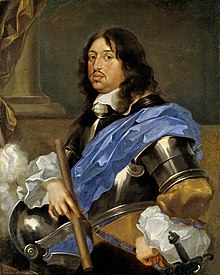
King Charles the Clueless
November 8th is also the birthday in 1622 of King Charles the 10th of Sweden, who spent most of his time trying to explain to the rest of the world that Sweden and Denmark are actually two completely different countries.  By far the most interesting thing about him is that he was actually King Charles the 4th.  But King Charles the 9th who was really King Charles the 3rd had chosen his number based on a book he read which he thought was a history of Sweden but which turned out to be a work of fiction.  Thank goodness no democratically-elected leader in modern times would ever rely on fictional stories to make important decisions (ahem).  The fact that George W. Bush had never read an entire book might actually have been for the best.


It is the birthday in 1836 of Milton Bradley, a wealthy Capitalist and entrepreneur who built a monopoly based on board games, which ironically did not include Monopoly!  Instead, Monopoly was the creation of a puritanical do-gooder who wanted to teach people about the evils and moral bankruptcy of Capitalism.  The game failed miserably in this goal, and instead became the means of introducing millions of children to the endless joys and wonders of Capitalism.  As a consequence, and much to her dismay, the self-righteous do-gooder became a fabulously wealthy Capitalist.

Also born on this day, in 1848, is Gottlob Frege, the German mathematician and logician who elevated Logic from something akin to the disreputable morass of Grecian rhetoric into a respectable branch of mathematics.  Presumably he did this in an effort to figure out what on earth his parents were thinking.  Next time you use an IF( ) function in Excel or draw a Chance card in Monopoly, thank Gottlob Frege.

Jack Kilby, Inventor of the
Calculator and the
Integrated Circuit.
One individual indebted to Gottlob Frege was the inventor of the integrated circuit, an item that makes prodigious use of Frege's formal mathematical logic.  Jack Kilby built and patented the first integrated circuit while working for Texas Instruments in 1958, and was promptly awarded the Nobel Prize.  Well, relatively promptly.  It apparently took 42 years for the news to reach Sweden.  (All their mail was being delivered to Denmark by accident.)  In any case, Jack's birthday could only be - you guessed it - November 8th!

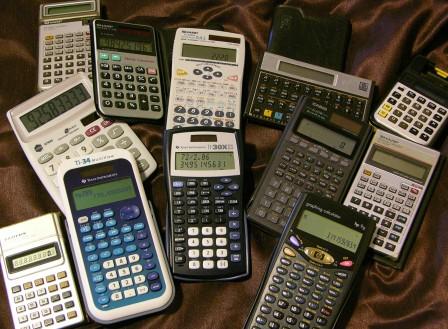
Jack Kilby was an engineer after my own heart.  He also invented the electronic calculator, which I regard as the greatest invention of all times.  If I could put just one item into a time machine and send it to my personal hero Galileo (who famously never did anything on November 8th if he could help it), it would be a solar-powered scientific calculator.  He really could have used one.  And I have a few extra, including the Texas Instruments TI-30X IIs, which in my studied opinion is the best calculator available today and a direct descendant of Jack Kilby's creation.

Some of the calculators I have owned and used.  Best Invention Ever.


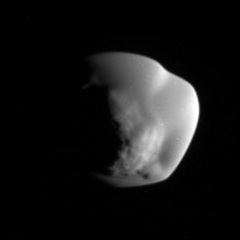
Atlas: Not Verified
This day is also the birthday in 1656 of astronomer Edmund Halley, who correctly guessed the periodicity of the object now known as Halley's Comet.   It is also the day before the birthday of astronomer and author Carl Sagan.  Twelve hundred years or so from now, November 8th will be celebrated by "millions and millions" of people throughout the inhabited Galaxy as Sagan-mas Eve.

Also in Astronomy, it is alleged to be the anniversary of the discovery in 1980 of a 15th moon of Saturn based on images taken by Voyager 1 (there are now at least 62 known moons of Saturn).  Try as I may I have not been able to verify this claim, nor verify that the fried-egg-like Atlas was that lucky moon.  Actually, this factoid is almost certainly wrong.  But if it were true, how awesome would that be?
2005 YU55.  Verified.

Verified, however, is the hair-raising near-miss of a 400-meter-wide asteroid, named 2005 YU55 for some reason, passing between the earth and moon on November 8 of 2011. Hey - that's TODAY!!!

If an object of that size were to collide with the earth, it's pretty much lights out for 90% of higher life forms on this planet, and even some politicians too.  The chances that it will do so are zero, however.  Its trajectory has been very accurately plotted, and it will definitely miss us.  We'll be able to get a much better photo of it, though, so that's a bonus.

Bram Stoker's character
scares the hell out of me.
Shouldn't we really call this a near-hit instead of a near-miss?


It is the birthday of scary Irish author Bram Stoker (1874), and notable user of language Gordon Ramsay (1966).  It is the day English poet John Milton regained paradise in 1674.


November 8 is the day in 1983 that the amazing James Booker left us for the sunny side of the street.  In honor of His Magnificence, please take a moment to listen to one of the great human achievements of all time:


So my friends, enjoy this absolutely amazing, one-of-a-kind day!  What will I be doing on this most auspicious occasion?  I am going to celebrate by laying in a hammock.


.

Wednesday, October 5, 2011

More Questions Than Answers

If you thought Science was just a big bag of facts, or that if Science doesn't know everything then it knows nothing at all, then I hope to enlighten you somewhat.  Science is the process of finding out which ideas are true and which are crap.

That is very hard to accept for soft-skulled people who think that all ideas are somehow equal.  Nature doesn't apologize for the fact that there exists an absolute truth, an objective reality of which Nature alone is the moderator, referee and adjudicator.   Our very subjective, fallible minds can only glimpse that reality through the rigorous discipline of scientific training in careful logical thought, painstaking observations, and tireless trial and error in which pre-judgement is necessarily suspended.

That is the nature of Science.  We may not always like the results, and often the process results in more questions than answers.  But in the long run, Science always increases our grasp of Nature's one Reality.

More questions than answers.  Such is the case with the 2011 Nobel Prize in Physics, shared by Saul Perlmutter, Brian Schmidt and Adam Riess.

(In Australia, the media will make a big deal out of the fact that Brian Schmidt, though US-born, works at the Australian National University in Canberra.  Australia claims 10 Nobel Prizes, 9 in Science, one in Literature, and a further 7 Nobel Prizes (including this one) either by Australians working abroad or non-Australians  living and working in Australia.  For a country of just 21 million people, this is considered an unbelievable performance in per-capita Nobel Prizes.  It is part of the complexity of the Australian psyche that Australians meticulously keep track of these kinds of things and see them as a matter of first importance.)

The 2011 Physics prize is for observations that prove the existence of something called "Dark Energy," an evocative name for the fact that galaxies in the universe appear to be accelerating uniformly away from one another.  It is as though the universe were perched on top of a hill, and as galaxies spread out in all directions, they leave the crown of the hill and begin to roll down the slopes, picking up speed.  The fact that we haven't yet discovered the reason for Space having this particular shape doesn't prevent galaxies from behaving in this way.

Previously, astrophysicists observed that the universe was much heavier than can be accounted for by all the stars and galaxies that can be seen plus all the gas and dust seen floating around between stars and galaxies, plus everything else they can think of to include in an inventory of all matter.  The rate at which galaxies are currently moving apart indicates that the overall gravitational attraction in the universe is larger than all known matter can account for.  They hypothesized that there must therefore be more matter in an unknown form, and called it "Dark Matter."

It is now understood that matter in all forms that we know, atoms, protons, neutrons, electrons, neutrinos, photons, quarks and so on, forms just 4% of the mass and energy in universe.  The rest is this Dark Matter and Dark Energy.

But before you go rejecting everything we've discovered in the last 300 years, consider this.  What was true yesterday is still true today.  Newton's equations of motion are still perfectly correct for everyday distances, speeds and times.  Einstein's Relativity, an extension  of Newtonian mechanics, is still perfectly correct for everything we've yet been able to observe. Quantum Mechanics is still the most accurate set of equations by far for predicting the behavior of atom-sized or smaller objects.  Thermodynamics is still absolutely inviolable when dealing with collections of 1000 or more atoms.  Energy is absolutely conserved in every interaction and "perpetual motion" is outlawed by the ruthless and absolute monarch of the physical universe, Nature.

Will Dark Matter matter to you?  Will Dark Energy be the lucky escape from our climate/energy dilemma?  Let me put it to you that any machine or device anyone could possibly make that will be larger than a single atom (what would you make it from otherwise?) or smaller than the Milky Way galaxy we live in, will still behave in complete accordance with the discovered principles of Nature we currently understand.

In fact, there is only one machine in existence which has a chance of working in a way that might surprise Science.  It was built in the hopes of surprising.  Although we understand exactly how it operates, the result it will have is not yet completely known.  That machine is the Large Hadron Collider at CERN.


Thursday, August 18, 2011

Believe in the Day

I have always been stirred by the following poem.  Not every day is one that I feel I can readily believe in, so it's good to be reminded that every day holds promise, power, hope, life and majesty.  Vast, incredible, expansive majesty from horizon to horizon.  If the day seems small or pointless to you, then get out, get up a mountain and have a look for yourself at how limitless and grand this day really is.

The poet and the wise man stand behind the gun,
Behind the gun!

And signal for the crack of dawn: Light the Sun,
Light The Sun!

Do you believe in the day? Do you?
Believe in the day!

The Dawn Creation of the Kings has begun,
Has Begun!

Soft Venus, lonely maiden, brings the Ageless One,
The Ageless One.

Do you believe in the day? Do you?
Believe in the day!

The fading hero has returned to the night,
To the night.

And fully pregnant with the day,
wise men endorse the poet's sight.

Do you believe in the day? Do you?
Believe in the day!


Can you name the poet and the title of the work?  Scroll down.

And for you astronomers out there, you really should be able to give the identity of the lonely maiden, The Ageless One, and the fading Hero.  (Hint: the lonely maiden is a giveaway.  The name of the celestial body represented is mentioned right in the poem.  Hint:  So is the name of The Ageless One, but it's slightly less obvious.)


Give up?  This is an excerpt from a much longer poem by 8-year old child prodigy Gerald Bostock, deservedly nicknamed "Little Milton," a student at Moordale Primary School in St. Cleve, England. Having once dragged myself all the way through Milton's "Paradise Lost" I can attest to Little Milton's stylistic similarity to the master, which in some ways eclipses the blind elder Milton's genius for charged allusion to natural imagry.

Gerald's mental stability is reputed to be questionable, for reasons not the least of which is the fact that Gerald is actually a fictional character (don't laugh - it could happen to you!) He is the literary creation of world-famous flautist Ian Anderson. Gerald's lengthy poem economically forms the libretto of one of Anderson's most ground-breaking musical compositions. The 44-minute piece, much of it in 5/4 time, titled "Thick as a Brick" was first recorded as a Pythonesque prank in 1972 by Anderson's progressive ensemble, Jethro Tull. ("Call that a prog rock concept album, do they? They wouldn't know one if it bit 'em in the arse.  I'll give 'em a concept album....")

The passage I quote occurs roughly 29 minutes into the piece where it occupies a tense and leisurely 6 minute interlude. Nothing I can say will prepare you for the full impact of listening to it.  It's somewhat like the feeling of being on a wonderful, relaxing vacation and facing a return to your job in the midst of a firestorm at work.  Can you really relax knowing what's coming?


Some Interesting facts about Ian Anderson:

He holds an honorary (though well-deserved in my opinion)  Doctorate in Literature (they don't just hand those out on the street, you know), but NOT a driver's license (which virtually anyone with a pulse can get).

Anderson bought his first flute and tried out it for the first time in 1967. Within just 6 months his flute playing was an international commercial success, including a top-10 album in the UK, winning over audiences who previously never showed much interest in the flute as a popular rock instrument.  This is a great album, by the way.

He taught himself to play flute, and only discovered he was doing it "wrong" 25 years later when his daughter took formal flute lessons in 1992.  (Can you imagine the pressure?  On both the student and the teacher.) By then of course he had already made millions playing the flute and was world-famous for it. Can that really be considered "doing it wrong?"


I wonder.


My favorite Ian Anderson Quote:

Upon winning a 1989 Grammy award for, of all things, Best Heavy Metal Performance, Ian said,

"Well, we do sometimes play our mandolins very loudly."


When you think about it, flutes are made mostly of silver alloy, which technically is a heavy metal.


Thick As a Brick    Thick As A Brick (Edit No 1) (2001 Digital Remaster)  Jethro Tull: A History of the Band, 1968-2001


PS  The fading Hero of the night is of course the planet Mars, the Warrior, who for all his endless conquering never gets what he really wants.