Showing posts with label Australian Creatures. Show all posts

Sunday, April 1, 2012

Australia Is Not for the Squeamish

What a weekend it's been.  The first thing I encountered when I arrived at the shed was the peculiar absence of any Redbacks.  Instead I was assaulted by a pong that no living thing could emit.

"Pong" is an Australian word that means a stench, smell, or bad odour.  This might explain why the video game industry had difficulty getting established in Australia after its disastrous first attempt.

The reason for the bad smell was immediately obvious.  My rodent bait blocks appear to be doing their job.  These two little fellows had the decency to "shuffle off" out in the open instead of crawling up inside the walls or furniture.  This way I could find them and give them a proper burial. Their rodent souls may have gone to heaven but their essence remains with us here below.  It took me hours to air out the Shed.


While I waited for the air to clear, I got busy building.  There is a chill in the air and winter isn't far off.  This brick hearth is for the wood stove I acquired last year, but was unable to use.  I finally found a flue for it in a building salvage yard, and the brickwork will contribute by holding the heat in longer.


But the most fun I had on this trip was a discovery I've been looking forward to since I last wrote about the abundant wildlife in and around the Shed during the peak of summer.  The alert reader may recall that I had thoroughly squashed a scorpion and was therefore unable to use it as a photographic specimen.  Well, this weekend I found another specimen!  This time, I held my stomping reflex in check.

I immediately recognized the terror-inducing primeval shape from across the room.  I got excited and prepared for the catch.  One useful thing I learned from my ex, a field entomologist, was how to really kill stuff dead while keeping it in one piece.  In one hand I grasped the BBQ tongs, and in the other I held a wide-mouth glass jar (ex-pickles) with a few inches of methylated alcohol in it.  All I had to do was grab the scorpion with the tongs and drop it into the alcohol.  Within seconds it would be perfectly preserved.

Not without some disappointment did I discover that the scorpion was already dead. Probably from the pong of dead mice engulfing the Shed.

Anyhow, for your viewing pleasure I can finally present to you, in full color, Scorpion Fluorescence.  Enjoy!


The Fluorescent Properties of Urodacus novaehollandiae under UV Illumination.

Get your very own  Ultraviolet Flashlight HERE.  Disclaimer: use of your UV flashlight may or may not be accompanied by weird sci-fi sounds and/or applause.  It all depends upon how AWESOME you are.


Saturday, January 28, 2012

Finally - Something Useful About Scorpions

My readers may be aware that I personally have little use for scorpions.  This peculiar little quirk of mine sometimes manifests itself in the act of stomping on scorpions with my boots.

Stomping on scorpions is often a futile act.  While it does annoy them somewhat, little else is usually accomplished.

But now, Research Engineers in China say there could be something useful we can learn from scorpions: how to minimize abrasive wear of engineered components.  In its essence, this paper hypothesizes that since scorpions live in sandy places that sometimes also are windy, this equates to scorpions being frequently sand-blasted.  And since there are very few news accounts of scorpions being killed by sand-blasting, they must have some secret to surviving sand-blasting attacks.

And because the researchers are Manufacturing Engineers and not Materials Engineers, the only possible reason that scorpions survive in sandy windy deserts must be the shape of their exoskeleton.  Another compelling reason to believe this is that the engineers have some really cool 3D laser scanning equipment that needs to be used.

Is this beginning to sound just a little Bogus to you, too?  Did it also occur to you as it occurred to me that scorpions survive sandstorms by - and this is just a crazy, wacky idea I had - Hiding?  Is it possible that scorpions, being alive (sort of), might be able to sometimes re-grow parts of their shell that get damaged or sand-blasted?

"No way," said the engineers.  "We've got this cool laser scanner that can resolve features down to 0.2 mm.  Plus we'll get to mess around with UV lights!  Scorpions are fluorescent, you know."

They make an excellent point.  As an Engineer, it's what I would have done, too.  But as a Scientist, I also have to look objectively at the data:


Notwithstanding the overly-optimistic conclusions of the researchers and that of the press, the data show that the presence of sub-millimeter grooves and ridges on a surface makes erosion worse under some conditions and better under others.  At best, if the direction of the abrading medium can be tightly controlled, manufacturing high-wear items with massively expensive tiny ridges could yield a slight extension of service life.

I knew it all along!  Damn scorpions are good for nothing.


.

Saturday, January 21, 2012

Fighting for Survival

They say we only grow when we struggle.  I haven't weighed myself for a while, but according to that statement which I now elect to interpret literally, I must be about 400 pounds.

Summer is always the most difficult time of the year in the Outback.  While Minnesota loses about half its population each winter (most are later found hiding in Arizona), the Australian Bush is something you really want to avoid in the summer.  Which ironically is at the same time.  So basically, January through March, we're all screwed no matter where we live.

I made it back to The Shed this 100° F weekend and was barred at the door by three large Redback spiders.  But they were no match for a stick and a half a can of spray.

Do Aboriginal people go around dot-painting
all the lizards in this country, or what?
Then I discovered that a colony of ants had appropriated an old sleeping bag for their nest.  There were signs of mouse activity, and some poison bait had been taken, but no sign of the corpses.  I'll bet the ants know where they are.  And, strangely, my new box of tissues was completely empty.

No fewer that two weird lizards of the kind shown here were living in the bottom drawer of the night stand where I keep a few extra sheets and towels.  It's actually a Thick-Tailed Gecko or Barking Gecko (Underwoodisaurus milii).  The lizards, I mean - not the night stand, which used to be an antique until someone painted it green and gave it to me for free.  The mice had been in there, too.  It's where every last one of my tissues was found, torn up into neat little squares for some reason.  I really think mice must be OCD.
A Lizards' Paradise.

And in case you're wondering, Barking Geckos really do bark.  They made quite a fuss when I grabbed them with BBQ tongs, plopped them into a saucepan (which I knew by experience they could not climb out of), and removed them to the woodpile away from the Shed.

To top it off, a very large black scorpion was in the Shed, strutting around the sleeping area as though he owned the place.  I had my boots off and feet up, reading this exact bookwhen I saw it out of the corner of my eye.  I put my boots back on, went over, and stomped on it as hard as I could.  It got really angry and tried to ignore me.  Must be the female of the species (which is most likely Urodacus novaehollandiae, definitely ultra creepy but not really dangerous).

So then I stomped on it again, even harder. This time, some guts came out and it finally stopped being a scorpion.

Another polka-dotted lizard in a cardboard box for some reason.
The alert reader will have noticed that if I stomped "even harder" the second time, then I could not possibly have stomped "as hard as I could" the first time.  Because if that were true, then I would not likely have been able to stomp even harder within such a short time.  Did my muscles undergo a miraculous 10-second growth spurt?  OK, I admit to the inaccuracy.  The first time, I only stomped as hard as I thought I needed to.  Which in my defense was pretty damn hard, but obviously not hard enough.  I'm sorry.

Because, as the alert reader is also surely aware, this was not my first time stomping on a large scorpion in my shed with my boot.  I have a certain amount of experience doing this.  And I have to say that this latest one was by far the largest and hardest scorpion I have ever stomped on.

I also discovered that although its carapace appears dark, almost black under normal light, this kind of scorpion glows bright green under UV light.  How on earth did I discover that, you wonder?  Simple.  Being the science geek that I am, I carry a UV light around with me and look at interesting things with it from time to time, when I suspect that the items might be fluorescent.  Bark scorpions in my native Arizona (much smaller but much more dangerous than these) are widely known to be UV fluorescent, and this is actually the best wayto find and eradicate them.  But the bark scorpion is also pale yellow under normal light, virtually translucent in color, so it was unknown whether a black scorpion would also glow under UV.  Now we know that it does.  The contrast between its color under normal light versus under UV light is really astonishing!

Flyscreen judiciously applied prevents critters from
living inside furniture.
I will attempt to get photos of this phenomenon next time, but all the heat was too much for my good camera's battery.  Which brings up the point I started out trying to make:  in the summer, one must work extra hard to keep a place like the Shed from being taken over completely by the creatures of the Bush.  And, it's too darn hot to really do very much besides spray a bunch of insecticide all around and wait until winter to try anything more ambitious.

I did manage to do this one thing:  I added flyscreen mesh to my antique green nightstand to keep mice and lizards from making it their future home.

If you have a cabin, a shed, a beach house, vacation dwelling, a "granny flat" out back or even a guest bedroom you don't use very often, then I recommend the following precautions:
  • All food must be in sealed cans, glass jars, hard plastic bottles, or buckets with tight-fitting lids.  No food can be left in cardboard boxes or plastic bags.  They will be opened and used to support an entire ecosystem.  
  • All sheets, towels, clothing or fabrics must be stored in sealed plastic bins. 
  • The backs and bottoms of dressers, chests of drawers, wardrobes, etc. must be sealed using flyscreen material or thick plastic sheeting (and mice have been known to chew through both).  
  • Something has to be done about the beds and mattresses. But I haven't figured out what just yet.
  • Gaps, nooks, crevices, and voids in doors, walls, furniture, ceilings and appliances where vermin can nest should be filled with expanding foam or thoroughly sealed up. 
  • All trash must be removed upon vacating the premises (my biggest problem - I keep forgetting to do this).
  • No water must be left available.  Roaches can live a long time on apparently nothing, but cannot survive long without water.  Plug drains, empty anything containing water that isn't sealed, and shut off supplies. 

Finally, DO NOT feel sorry for them for even a moment.  They can, and should, survive just find outside where they belong.


.

Friday, December 9, 2011

The Most Wonderful Time of the Year

Well, it's finally December, and you know what that means, right?

Tinsel?  Lights?  Santa?  Presents?

Wrong!  At the Shed, December always means . . .


SPIDERS!


Lots and lots of spiders.  Colorful, festive spiders adorning everything.

The entire block (where the Shed is) is presently criss-crossed between every tree, shrub, bush and plant with spiderwebs.  Peter Jackson could film most of The Hobbit right here and save a fortune on fake webs and giant spider animatronics.  Plus my recently-acquired ear hair qualifies me to be an extra in the film, maybe even a supporting extra.

I was up there a few days ago checking on the rainwater tank (finally full, which I determined with just a glance at a most ingenious tank gauge)  and making sure the drip irrigation system was in good order for the start of summer.  This simple task was rendered almost impossible because I literally could not move an inch or turn around on the spot without going straight through some spider's ludicrously ambitious web, some of them eight feet across.  I had to carry several sticks with me at all times (second most useful thing ever) and constantly wave them around, high and low.  If I passed through one way, there'd be a new web in the spot by the time I returned.  At one point there were three bewildered spiders clinging to my stick at the same time probably asking themselves in their creepy spider language, "Why, God?  Why is this happening to me?"

The main culprit in all this Holiday Madness is called the Christmas Spider.  Now tell me this: what the hell kind of country has something called a Christmas Spider? But there we are.  Deal with it.

Christmas Spider photographed at The Shed

Austracantha minax is a type of Orb Weaver found only in Australia, and is also known as the Christmas Spider, The Australian Jewel Spider, the Spiny Spider, and for some reason, "Bowser Henderson."  Are you finally convinced that Australia is the strangest place on Earth?  As though Mel Gibson and Steve Irwin wasn't proof enough.  Then tell me, what other country in the world would name an entire species of spider "Bowser Henderson?"*  (SEE BELOW - NOT TRUE)

They show up in late November, and by Christmas there is a spider sitting in a web filling every possible web-making space in certain parts of the outback.  A month later, they are nowhere to be found.  They celebrate Christmas by feasting on the explosion of moths, mosquitoes and other flying nuisances that erupts this time of the year, and then vanish until next holiday season.

We're just crazy about Christmas here.  Australia also has something called Christmas Island, but you wouldn't want to go there.  It has no snow, no elves, and nothing even remotely resembling Holiday Cheer. It is most famous as the location of a concentration camp for refugees who are permanently detained by the Australian Government while politicians decide how best to use them to their electoral advantage.  Unfortunately, most politicians can only see their existence as a political disadvantage and are simply hoping the problem will go away if they ignore it long enough.


Christmas in Western Australia also means Christmas Trees, of course.  But it wouldn't be Australia if that, too, were not also weird and a little bit sinister.  A Christmas Tree is a parasite (technically, a hemiparasitic plant) somewhat related to Mistletoe (so there's that, anyway), which bursts out in the most violent day-glow orange display each December.

This large, free-standing plant known scientifically as Nuytsia floribunda and found only in Western Australia uses its roots to tap into and hijack the roots of almost any other tree or plant to obtain the nutrients it needs.  When the colorful Christmas Trees are in full bloom, that is a signal for everyone to get ready, hang up their stockings and watch out for . . . Santa?  No!  Spiders.  Hang up your stockings and anything else that you don't want spiders getting into.

Nyoongar aboriginals consider it to be extremely poor manners to cut down one of these trees.  Oh, it might bring bad luck, who knows.  Anything's possible, I suppose.  But these trees are an excellent source of shields fashioned from bark, and produce an edible resin gum.  And they make a pretty cool natural calendar, too.


Have a Holly Jolly Creepy Crawly Christmas!  And don't forget to BUY STUFF.  The economy needs you.


.
* This "Bowser Henderson" factoid sounds a lot like bullshit, doesn't it?  Interestingly, wikipedia is the only reference to this usage (other than sites that just copy whatever wikipedia says), and it is looking more and more like bullshit as I continue my attempts to verify it.  I suspect it is someone's private joke on the world, because the name doesn't appear to have any cultural or popular meaning.  I am attempting to raise the question with Australia's leading spider and lingual experts.  I will keep you informed.


UPDATE 17 DEC 2011:  I have been in communication with a spider expert at the South Australian Museum who agrees that this "Bowser Henderson" thing is probably bullshit.  He has never heard of it.  I have also been in contact with an expert in Australian Linguistics who knows more about Australian slang, regional terminology and dialects than probably anyone alive, and he says he's never heard of it.  He surmises it may be a term used only within the contributor's own limited circle, own family, or possibly even within his own mind.   Therefore we will declare that this factoid is BUSTED and  "Bowser Henderson" IS NOT a "commonly used" alternative name for the Christmas Spider at all.    -j.j.

Sunday, October 23, 2011

When Lizards Attack

I was just minding my own business when a gigantic ferocious Australian lizard leaped out of nowhere, grabbed my arm, bit my finger clean off, then began dragging me by the neck off to its lair!!!  Fortunately Yvonne came out with a shotgun and blew its head off just in time!!!

That's the kind of blog post that my readers have come to expect.  What really happened varies slightly from the fictionalized account.

I was cleaning up the back patio and disturbed the tiny, shy lizard's hiding spot.  I cornered him in a plastic tub from which he was unable to escape, and picked him up to get a look at him.


AND THEN HE BIT ME!  Yes, that part is technically true, I got a microscopic nip on the finger that I could almost feel.


The tiny docile gecko then slinked up my arm and onto my shoulder just as Yvonne came out of the house and shot it several times.

With the camera, of course!


Then we let it go. Australia isn't always as exciting as it is made out to be in the media and on certain internet sites.  And thank goodness for that.


.

Saturday, October 1, 2011

Kookaburra

The Laughing KookaburraDacelo novaeguineae of the Kingfisher family (one of two species in Australia), was introduced to Perth in 1898.  It is not native to Western Australia. 


Its name comes from an extinct aboriginal language and means "Hahahaha heeheeheehee hahaha hoo hoo hoo hoo heheheheheheheh," which is also an approximation of the bird's unmistakable call.


Photographed at Bindoon this week. 


Kookaburras are smart and fearless.  I knew of a particularly smart one at the University of Western Australia where he held the position of professor of experiential ornithology and notorious sandwich thief.


Sitting on the branch of a tree some thirty-five feet away from an open-air cafe on the verandah of the library, this bird could time his flight so perfectly and anticipate humans' actions so well that he could leave his branch just as you picked up your sandwich and as you lifted it to your mouth, snatch it right out of your hands, zooming inches past your face.  He would then alight at a nearby table and eat your sandwich in front of you, daring you to do something about it. 


Kookaburras also hunt lizards, snakes, small mammals, and many, many cute baby ducklings.  So they can't be all bad.


All-You-Can-Eat Breakfast Buffet for the Kookaburra

And in case the name Kookaburra becomes too boring for you to utter, you can choose from these nicknames:

Bushman's Clock
Ha-Ha Pigeon
Breakfast Bird
Jacko
Photographed in 2005


Wednesday, September 21, 2011

RedBack Where I Belong

Latrodectus Hasselti, or the Australian Redback Spider, normally does not come out during the day, preferring to hide in small crevices close to the ground.  Since we have been getting a lot of rain the last few days (this being towards the end of the Australian winter and Perth's wet season), I hypothesize that this small-ish specimen has been temporarily flooded out of her usual abode.  This provides you and me with a very rare opportunity!

There it was, up close, not moving, with the remains of a recent meal nearby, and with scarcely a thought of springing suddenly onto my face and biting my nose.  This doesn't happen very often.

On Monday, I got out the Nikon, grabbed the small Tripod and waited for the sun to come out.

On Wednesday, the sun came out for a few moments.  And here are the results:


Latrodectus Hasselti, Australian Redback Spider
A crevice of a brick wall isn't the greatest place to try to hide, but it might have gotten away with it had it not been right next to the front door of my house where I had to nervously edge past every time I came or went.  But it's still far better than the time I shared a shower with one of these creatures dangling by a single strand of web inches from my unclothed torso.

My reaction then was to immediately and decisively drop the soap and say, "WTF?  Are you KIDDING me?"

See, that's what the experts say you're supposed to do.


As a reward for posing so obligingly for these photos, I generously provided this creature with a lifetime supply of imiprothrin (0.7 g/kg) and cypermethrin (2.0 g/kg) in aerosol form.  That's only about one half-second squirt, seeing as how its lifetime was to be just 45 more seconds.

Saturday, September 17, 2011

I Remain Unconcerned

I only looked up because of the noises caused by this behemoth crashing into things while flying around the Shed.  I am TRYING to read, if you don't mind!  The noise didn't stop, so with a sigh of exasperation I got up, found a jar, caught the thing, and popped it in the freezer.  Then I went back to my book, "The Nutmeg of Consolation."

A chapter later, I remembered the bug.  Oops.


It had a lot more fur than I feel is strictly necessary, a hard shell, and far too many sharp barbs on its legs.  It was also about the size of my thumb.

The human mind has the ability to magnify things according to how unpleasantly they are behaving.  This means that if this bug were buzzing around your living room, it will appear to be the size of a tennis ball.  If your wife sees it in the kitchen, she will observe it to be the size of a grapefruit.  In the bathroom, it will appear to be about the size of a basketball.  

Resting on your pillow, it actually dwarfs a Labrador.  And is twice as hairy.

But in the Shed it's just another Australian bug.  Albeit one of the larger ones I have personally been brave enough to touch, even when frozen solid.

Monday, September 12, 2011

More Bugs Than You Can Shake a Stick At.

And believe you me, you can shake a stick at an impressive number of bugs if you set your mind to it.  I had the opportunity once, in the back room of a natural history museum where there was row after row of cabinets full of insect storage trays.  There were so many, I was only just able to shake a stick at them all.  Thousands upon thousands of separate species of bugs of every kind, each identified, pinned and labeled in a tray with scores of other species all meticulously sorted by genre and family, the culmination of many lifetimes of dedicated work.  What a waste!

They're only bugs, after all.  A couple of cans of Raid could have sorted them out just as well.  And if you want to see bugs in endless variety, just come out to Australia.  The coastal scrubland north of Perth has nothing remarkable about it until you take a closer look.  Some 40 million years of geological stability created the right conditions for an explosion of biodiversity, resulting in perhaps millions of species of plants, insects and and spiders, many of which are still unknown to science.  That Noah must have had to make thousands of trips down here and back, and he must have been really good at catching spiders.  I wonder that Mrs. Noah didn't have something to say about it.

But for someone who cares nothing about words like "biodiversity," "genre," and "Linnaeus," they're just curiosities that wander in front of my camera lens from time to time.  Sometimes making a detour through my freezer to make them more compliant models.  Five minutes usually does it, and as they slowly thaw out and stretch their ridiculously numerous limbs, you can take all the pictures you want from every angle.  Longer than that, and they come out dead.  Be careful not to forget and leave them in the freezer for weeks, because someone might find your frozen specimens and think you're some kind of a psychopath who is starting out small.  Or that you have some very odd dietary habits.

Below is a gallery of just a few of the weird creatures I have encountered by doing nothing more than hanging around Western Australia with a camera. Imagine what a really dedicated person could do.  Bore us all to tears, most likely.

Remember, you can click on the images to see them larger.


The blue-green eyeballs of this large fly caught my attention.  The exquisite detail and subtle coloring made no difference whatsoever when my swatter got involved.


I don't know about you, but I've never really looked deeply into a cricket's eyes before.  Don't think I'll bother doing it again, though.  It's kind of creepy.


I discovered this large Redback living inside one of my son's outdoor toys when he was about five.  Constant vigilance is essential.  Panic is optional.


Lest we paint all Australian critters with the same malevolent brush, here's a friendly, harmless and cute (in his own way) animal my son kept as a pet for about 6 months.  He named it Pickett, The Bush Cricket.  He had a soothing melodious song played by sliding his wings together that went something like "zzzzzzzzzzzzzZZZZIP!"  OK, it got a little repetitive after about the 400 thousandth time, just like the original Pickett. But he didn't eat much, didn't get hair all over everything, never at any time chewed the cord off my power drill, and never needed to go to the vet.  Except maybe once, but by the time we knew anything about it, it was too late.


Also friendly and harmless is this Walking Stick I found, seen here posing for the camera.  I only wish I could somehow give you a sense of its true size.


Harmless weevil, wondering where the heck he is.

Another marginally less harmless weevil, this one of the Punk variety.

If you were forced to eat one of these, which one would it be?  That's right.  You must always choose the lesser of two weevils.

Weird Bug in the shape of a hairy bowler hat.


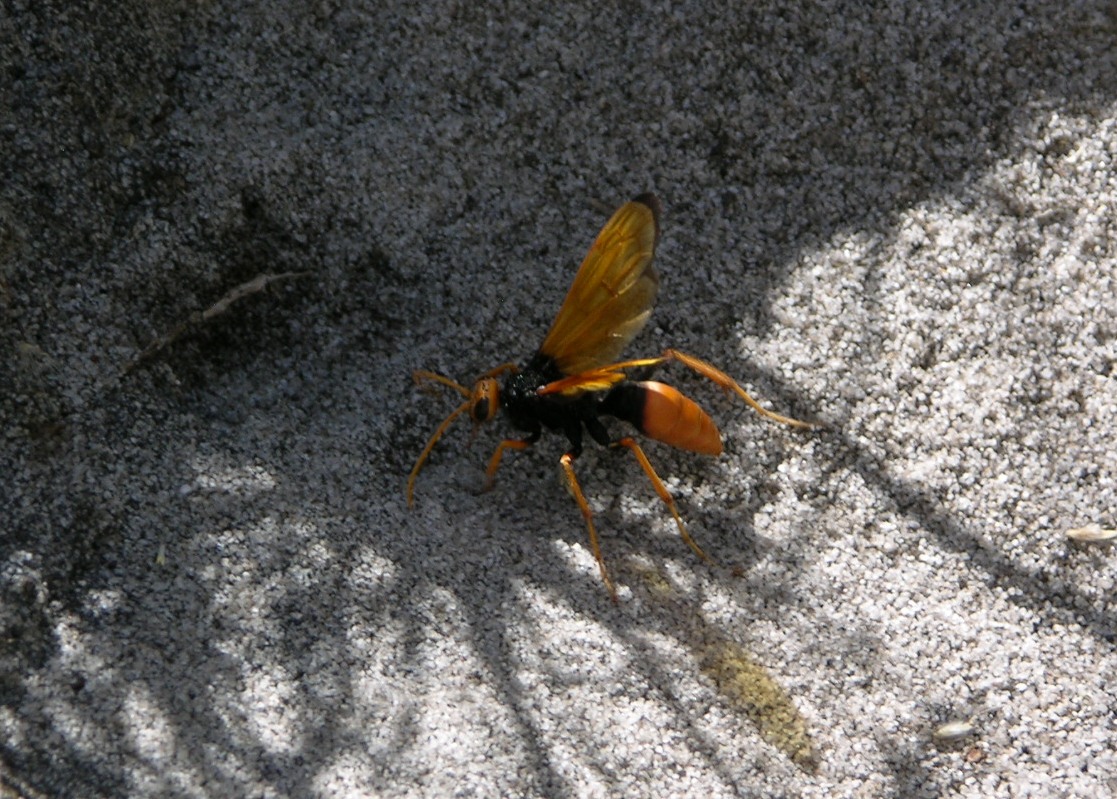
Scary orange and black wasp, digging a hole.  Yes, it shocked me too.  No, I can't imagine why, either. But there it was.  Digging for all it was worth.


Feathery moth caught in the rain.


Ghostly grey spider.  Never seen anything like it before or since.


Nasty, evil Kangaroo Tick.  I do not like them, Sam I am.  I do not like them on a farm, I do not like them on my arm.  I will not have one as an egg, I will not have one in my leg.


At first I didn't realize this was a bug at all.  Then I saw it move!  It is the strangest thing I think I've seen yet.  Is it a type of cricket that has been stretched out?  What does it imagine in that tiny brain that it is doing in my Shed?


See, THIS is what a cricket is supposed to look like.

Except perhaps not quite so . . . pink.


Fancy Green Moth.  I find it easier to name them myself rather than trying to look it up somewhere.  It's less work that way.

One more:


Christmas Spider.  Would somebody tell me, please,  what the hell kind of place has Christmas Spiders?  Halloween Spiders, OK.  That would probably work.  But spiders just don't go with any Christmas I understand.

I suppose they are somewhat festive and decorative in a way.  Maybe it's an Australian thing.  More on these come December at The Shed.

Saturday, September 3, 2011

What's Happening This Weekend

It was a quiet week in Lake Shedbegone.  Oh, wait.  That's someone else's schtick. I'll try to be more original.

Stopping at a grocery store on the way out of town, I found some veal that was on sale and thought I'd give it a go along with a baked potato with sour cream and some onions caramelized in my cast-iron skillet.  It was "ok," but for my money I'd rather have a nice thick melt-in-your-mouth porterhouse or t-bone.  No sauce or seasoning required other than a few shakes of pepper.  Sear on both sides, cook a few minutes on one side, then turn and wait until it bleeds on top.  Perfect medium-rare every time.  Mmmm.  As my great-grandpa might have said if he had thought of it, "If people aren't supposed to eat animals, why are they made out of meat?"

Bricks are perfect for keeping
things off the ground.
Other than some amazingly good hammock time, Saturday was spent re-stacking firewood.  Eucalyptus trees come in dozens of species, and each one is a little different.  Generally speaking though, seasoned wood cannot be cut because it's too hard, and green wood cannot be split because it's too resinous. Providing firewood is therefore an unforgiving art requiring attention to detail:

  1. Fell the tree and immediately cut into stove lengths while the wood is still green and fresh.
  2. Allow to dry for a couple of years.
  3. Split larger diameters with a splitting maul when it is dry.
  4. At no time allow the wood to rest on the ground, where it will be devoured by termites in a matter of months. 


Saturday was also a chance to finally install a small fluoro light I got for free from a salvage yard.  Figuring out how much to charge and collecting the money was way more work than the bloke there was prepared to do, so he just said, "yours, mate."  It didn't have a power cord and it was covered in filth, dirt and muck, looked absolutely worthless.  But when I was finished with it, it looked and worked like new.  I found a suitable cord in one of the many boxes of random junk that the Shed contains, and fitted it in a jiff.  I am thoroughly de"light"ed by this find.  Absolutely the perfect thing for the food-prep work bench I had built using 100% found scrap timber.

Except for the fridge, everything seen here was found or gifted for free - electric kettle, toaster, and toaster oven.  Actually, the microwave was my wife's old one because the one I found during Bring Out Your Dead a few years back was way better than this.  We use the "recycled" one at the house and her old one now lives at the Shed.


This weekend also saw progress on a secret new woodworking project.  Well, if I told you, it wouldn't be secret then, would it?  Patience.

This rotted, weathered old piece of Jarrah (a native Eucalypt hardwood) was a diamond in the rough.  A bit of sanding revealed some gorgeous grains and the beautiful rich red that is the hallmark of Jarrah.

But the big event this weekend was this stowaway I picked up on the inside of my upper arm, probably while stacking firewood.  I have tried all the recommended ways of removing ticks, and none of them work for me except grabbing them and pulling them straight out.  I tried the vaseline thing to encourage it to withdraw its mouth parts from my flesh, but the tick did nothing.   Never made a move.  It appeared actually to be dead.  The same thing happened last time.  It was much larger.  And in my navel.  Why do ticks always seem to die when they take a hearty swig of Johannesbräu? Perhaps kangaroo ticks have not evolved to feed from a host that subsists largely on a diet of Mexican food.

Which I don't mind telling you, is bloody hard to find around here, mate.  Sure, there are food-like substances claiming to be Mexican, but so far as I can determine, these mystery meals are little more than Disappointment itself.  I have to either make my own Mexican food or suffer the 36 hour ordeal that is a trip home to Phoenix, Arizona.

Tuesday, August 30, 2011

The Battle for the Shed

I'm not above resorting to chemical warfare to protect my property and ensure my personal security.  Especially when my enemy has way more legs than I do.

Basic food cooked simply.
Pancakes for breakfast.
The Shed is a place I go to get out of the press of a busy city.  You may not think of Perth as any more hectic than your typical coma, but I still like to get away from the traffic, noise and crowds, such as they are.  Plus, the house I live in is too small to have any kind of workshop or space for my hobbies.  It is also so close to the neighbors that I can hear their phone conversations and smell their cigarette smoke.  Probably the most revolting stench in the world.

Every week or so, particularly when the neighbors have a loud party, I get out of town and head up to the Shed to re-charge, re-focus, de-stress, look for hope and meaning, and generally take stock of things.  The Shed provides me with the solitude, silence and fresh air that I need for that.  It also gives me the chance to do things that I really enjoy, to work on projects, write, pursue hobbies, read, or just lie in my hammock in harmony with nature, peacefully thinking of ways to finally get the bastards.

Chili with cornbread and a cold
Ginger Beer.

At the Shed I eat basic food cooked simply.  Baked potato roasted in the coals of a fire, a porterhouse grilled in a cast iron skillet with an onion which I slice up using a Swiss Army knife (a surprisingly useful item). Once, however, I prepared an entire Thanksgiving feast in the Shed for my son and myself, which he didn't touch.  Apparently he "doesn't like" turkey.  On winter evenings I light a fire in the stove; at sundown in the summer I get out the telescope (a 7" Maksutov on an equatorial mount) for some astonishing southern hemisphere stargazing.

There's always work to be done too: things to build, firewood to cut, trees to plant and irrigate, rain gutters to keep clear, tools to sharpen or repair, and improvements to make.  On one occasion, however, the Shed offered me something I wasn't expecting.

Protracted Warfare with an Entrenched Enemy.

The Australian Redback
(shown not fully mature)
It was one of those Friday afternoons.  I arrived at the Shed full of care and eager to begin ignoring my burdens for a day or two.  I unlocked the gate, drove the Toyota light truck around to the back and parked it.  I grabbed my overnight bag and the weekend's groceries out of the truck, unlocked the door to the shed, and stepping inside, put my face straight into a spider's web.

Not just any old spider, either: a RedbackLatrodectus hasselti, highly venomous cousin of the American Black Widow, Latrodectus hesperus.  I have heard that some scientists were claiming these to be genetically subspecies of the same species, but I can't find a reference to that factoid today.  The markings are different, and the Redback's black body is more of a velvet matt compared to the Black Widow's high gloss black.  But if you happen look underneath a Redback (as one does), you can see the same red hourglass that is the Black Widow's trademark.  I also am convinced that the Black Widow's silk is at least twice as strong as a Redback's.  Much of my suburban Arizona youth was spent battling the dreaded Black Widow, whose silk is pound for pound stronger than steel and makes a distinctive crackle when a stick is dragged, with some considerable effort, through a web.

Redbacks also have
the hourglass marking.
After doing the creepy-spider-creep-out dance for the requisite five minutes outside the Shed, I promptly acquired a sturdy stick (which, according to Douglas Adams is the second most useful thing ever).  I re-entered the shed by knocking down the web covering the doorway with my stick.  Then another web after that, and another.  I looked around me and discovered I was in way over my head.  There were Redback webs covering every surface of every item in the shed and spanning every space available. Every web had at least a tiny pale hatchling Redback spider on it, though quite enough of them were considerably larger and more mature.  I had walked into the middle of an infestation.  Not just an invasion, a total Redback occupation of the Shed.

My main weapon against Redbacks is a spray bottle of the kind that you put a mixture in and pump up.  I also keep a small bottle of concentrated pyrethrin-based insecticide in the Shed.  On this occasion it would do me no good, however.  I looked wistfully at my spray bottle and at the very large Redback that had made her web right on top of it.  I waved my stick thorough its web, hoping to retrieve my one effective weapon, but that caused the Redback to retreat INSIDE the handle of the sprayer, rendering the sprayer completely inaccessible to me.

Fighting my way back out of the shed, I regrouped at the truck.  I had been beaten.  Defeated, for the moment.  I needed reinforcements.  I needed The Warrior to take charge.  But he'd better hurry: in a few minutes the only shop in the tiny village of Bindoon would close for the night.

In a moment, I was back in the battered old Toyota, my foot planted hard on the accelerator, barreling down the road racing around corners like my hair was on fire.  That is to say, driving just as I normally do whenever I get behind the wheel. I made it to the shop moments before it closed.  I purchased the town's last two cans of insect spray, and pointed the truck once again towards the Shed and its hundreds of eight-legged interlopers.

My plan was simple.  Taking a page from Lord Nelson of the Royal Navy, who said, "Never mind maneuvers, always go straight at 'em," I took a stick in one hand, a can of spray in the other and tucked the second can into my belt.  Entering the Shed, I sprayed everything within reach, then knocked away webs to push further inside the shed.  The spray's neurotoxins work quickly, but a writhing Redback is still capable of planting a deadly bite before it permanently points its legs to the sky.  I had to watch that my victims were not climbing up my boots or dropping onto me from overhead webs.

Finally, in the fading light of the afternoon and with both cans of spray totally exhausted, I made it back out of the Shed with my newly liberated pump-sprayer and the bottle of pyrethrin mix.  Using a small stick I dislodged the still-twitching corpse of a Redback from the sprayer handle, filled the 1-litre tank with an extra-strength mix of insecticide, and went back around the entire shed, drenching every object and surface in bug killer, including the walls, ceiling and floor.  This mix dries on the surface and kills anything that walks on it for up to 3 months. It gets scorpions, centipedes, spiders, ants, flies, tics, roaches, anything with more legs than are strictly necessary, in my opinion, for locomotory propulsion.

I resolved that day to maintain the Shed's defenses more diligently in the future.  A Redback can have a thousand offspring at one go, and to avoid a repetition of this near-disaster I would not leave the Shed vulnerable to an infestation again.  Every visit to the Shed begins with a thorough scan for those telltale lopsided-pyramidal webs that always mean Redback, and every three months the entire shed gets baptized anew in pyrethrin.

Of course total security is never more than an illusion.  I don't want to kill every scorpion, Redback, or centipede on my entire block of land; only the ones that get ideas about turning my Shed into some kind of . . . spidery . . . place where spiders are.

I think I need a break.  Time to head for the Shed, put my feet up for a while.