Monday, September 12, 2011

More Bugs Than You Can Shake a Stick At.

And believe you me, you can shake a stick at an impressive number of bugs if you set your mind to it.  I had the opportunity once, in the back room of a natural history museum where there was row after row of cabinets full of insect storage trays.  There were so many, I was only just able to shake a stick at them all.  Thousands upon thousands of separate species of bugs of every kind, each identified, pinned and labeled in a tray with scores of other species all meticulously sorted by genre and family, the culmination of many lifetimes of dedicated work.  What a waste!

They're only bugs, after all.  A couple of cans of Raid could have sorted them out just as well.  And if you want to see bugs in endless variety, just come out to Australia.  The coastal scrubland north of Perth has nothing remarkable about it until you take a closer look.  Some 40 million years of geological stability created the right conditions for an explosion of biodiversity, resulting in perhaps millions of species of plants, insects and and spiders, many of which are still unknown to science.  That Noah must have had to make thousands of trips down here and back, and he must have been really good at catching spiders.  I wonder that Mrs. Noah didn't have something to say about it.

But for someone who cares nothing about words like "biodiversity," "genre," and "Linnaeus," they're just curiosities that wander in front of my camera lens from time to time.  Sometimes making a detour through my freezer to make them more compliant models.  Five minutes usually does it, and as they slowly thaw out and stretch their ridiculously numerous limbs, you can take all the pictures you want from every angle.  Longer than that, and they come out dead.  Be careful not to forget and leave them in the freezer for weeks, because someone might find your frozen specimens and think you're some kind of a psychopath who is starting out small.  Or that you have some very odd dietary habits.

Below is a gallery of just a few of the weird creatures I have encountered by doing nothing more than hanging around Western Australia with a camera. Imagine what a really dedicated person could do.  Bore us all to tears, most likely.

Remember, you can click on the images to see them larger.


The blue-green eyeballs of this large fly caught my attention.  The exquisite detail and subtle coloring made no difference whatsoever when my swatter got involved.


I don't know about you, but I've never really looked deeply into a cricket's eyes before.  Don't think I'll bother doing it again, though.  It's kind of creepy.


I discovered this large Redback living inside one of my son's outdoor toys when he was about five.  Constant vigilance is essential.  Panic is optional.


Lest we paint all Australian critters with the same malevolent brush, here's a friendly, harmless and cute (in his own way) animal my son kept as a pet for about 6 months.  He named it Pickett, The Bush Cricket.  He had a soothing melodious song played by sliding his wings together that went something like "zzzzzzzzzzzzzZZZZIP!"  OK, it got a little repetitive after about the 400 thousandth time, just like the original Pickett. But he didn't eat much, didn't get hair all over everything, never at any time chewed the cord off my power drill, and never needed to go to the vet.  Except maybe once, but by the time we knew anything about it, it was too late.


Also friendly and harmless is this Walking Stick I found, seen here posing for the camera.  I only wish I could somehow give you a sense of its true size.


Harmless weevil, wondering where the heck he is.

Another marginally less harmless weevil, this one of the Punk variety.

If you were forced to eat one of these, which one would it be?  That's right.  You must always choose the lesser of two weevils.

Weird Bug in the shape of a hairy bowler hat.


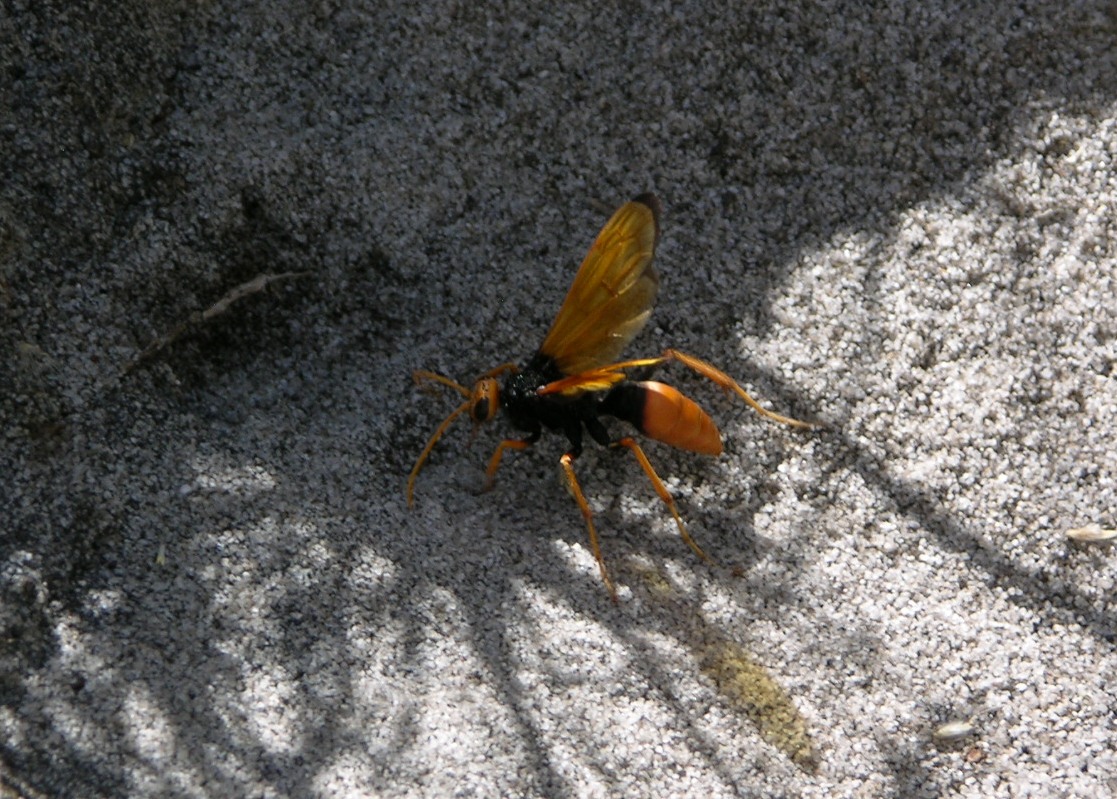
Scary orange and black wasp, digging a hole.  Yes, it shocked me too.  No, I can't imagine why, either. But there it was.  Digging for all it was worth.


Feathery moth caught in the rain.


Ghostly grey spider.  Never seen anything like it before or since.


Nasty, evil Kangaroo Tick.  I do not like them, Sam I am.  I do not like them on a farm, I do not like them on my arm.  I will not have one as an egg, I will not have one in my leg.


At first I didn't realize this was a bug at all.  Then I saw it move!  It is the strangest thing I think I've seen yet.  Is it a type of cricket that has been stretched out?  What does it imagine in that tiny brain that it is doing in my Shed?


See, THIS is what a cricket is supposed to look like.

Except perhaps not quite so . . . pink.


Fancy Green Moth.  I find it easier to name them myself rather than trying to look it up somewhere.  It's less work that way.

One more:


Christmas Spider.  Would somebody tell me, please,  what the hell kind of place has Christmas Spiders?  Halloween Spiders, OK.  That would probably work.  But spiders just don't go with any Christmas I understand.

I suppose they are somewhat festive and decorative in a way.  Maybe it's an Australian thing.  More on these come December at The Shed.

Thursday, September 8, 2011

How To Lie in a Hammock

It's not junk food. It's not driving slightly over the posted limit. It's not carrying a few extra pounds around the middle. It's not chlorine or fluorine in the drinking water. It isn't those overhead high-voltage power lines (an awe-inspiring monument to what separates Man from the animals: his ability to make electricity). Neither is it drinking from plastic bottles, cooking salty food in a teflon pan, or licking cholesterol-based pork-flavored frosting directly off of aluminium pots. It's not even duct-taping a dozen active cell phones to your head and calling all of them at once. None of these things can actually kill you.

Stress is the real killer. Do something about stress, and these other risk factors take care of themselves. Ignore stress, and you're caught in a non-stop game of whack-a-mole with a never-ending stream of environmental health hazards, many of which you can do nothing about.  But what can your average Joe do about stress?  Plenty.

When men are relaxed, composed, well-rested and get the required amount of sleep, they perform better on the job, have stronger marriages, have better relationships with their kids, fewer car accidents, fewer health problems, more hair, and a longer schwanz.

(Well, probably.  We haven't actually tried to get data on that last one.)

Men, it is virtually YOUR DUTY as a husband or father to go lie in a hammock. RIGHT NOW!

Here's how to make hammock-time a safe and enjoyable means to a longer, happier life, rather than the painful, embarrassing Funniest-Home-Videos experience it has the potential to become.

1. Find two stout trees in a quiet location that are 12 feet apart and each at least 8 inches in diameter. I strongly advise against hammocks slung on a metal frame, between posts of a patio, or on hooks screwed to a wall or ceiling. No hook, eye bolt or screw from a hardware store will do the job, and 2x4s or even 4x4s are not suitable. You need trees.

If the trees are too close together, your bum will drag on the ground. If they are too far apart, your bum will drag on the ground. Weird, isn't it?  It's paradoxes like that which motivated me to study physics and mathematics in the first place.  The really important questions in life.

2. Get two pieces of strong rope, half inch diameter give or take, about 5 feet long, but long enough to wrap around your trees three times with a foot or two left over. Tape and melt the ends to prevent fraying (if natural fiber, tape or lash the ends and apply glue).  I like to wrap the rope in tape at the cut before I cut it, to forestall any unraveling.

3. One end of the rope attaches to the loop on the end of your Hammock as shown. Pass the end through the loop, behind and around the hammock cord, and then under itself. Do not make a more complicated knot than this, because a) it will not hold any better, b) it will be more stressful on you and on the rope.  The secret to hanging in there for the long haul (physically and metaphorically) is to manage stress and keep things simple.
Second pass: goes under first pass.

4. The other end of each rope is wrapped around a tree at about head-height like this. The second pass goes under the first, on the side of the tree facing directly away from the other tree. The third pass makes a loop which is put under the second pass as shown. Why a loop? When it starts raining you can pull this end of the rope and have your hammock stowed away in seconds flat. Again, don't try to make the knot more complicated. If done correctly, the rope will break long before this knot ever lets go. The bark of the tree provides friction against the rope, so don't attempt this on metal poles, smooth timber posts, or on anything other than a natural tree, or with anything other than twisted multi-strand rope.
Third pass: loop held by second pass.


5. See that the hammock hangs approximately as shown (below). If it hangs too slack, it will be uncomfortable. If it doesn't hang enough, you could break the ropes and end up with a bruise on your backside and your ego.

A Catenary.
6. Lie diagonally across the hammock, not lengthwise. Hammocks are more stable this way, and you will not flip over and fall flat on your face to the utter glee and amusement of anyone who happens to be videoing you on their cell phone.

An empty hammock forms a geometric shape called a Catenary. It is the solution to an elliptical integral equation which has no simple algebraic form. It is one of Nature's most beautiful shapes, in my opinion. Interestingly (well, to me anyway) it is also the shape assumed by a thin, flexible elastic object, such as the blade of a saw, when the ends are pushed towards one another.

When a typical 200 pound man sits in the middle of a hammock, how much tension is on each rope? Would you say one hundred pounds, which would be the total weight shared evenly by the two ropes?  No! This is why many hammocks fail.  The rope tension is actually much higher than that. If the trees are 12 feet apart and the total hammock length is 15 feet, then the rope tension is 167 pounds. If you shorten the hammock by 1 foot, the tension increases to 194 pounds. Taking another foot off makes it 260 pounds. I'll leave the details of the vector geometry for the reader to do as an exercise.

As the hammock is shortened so that it doesn't hang down at all, the force theoretically approaches infinity. But long before that happens, the trees lean inwards to reduce the tension, or the rope stretches slightly, or something breaks.  Again, do not use metal hooks, screws, bolts, hangers, eyes, or anything from a hardware store other than good, honest rope and two solid trees in a quiet location.  If these steps are followed to the letter, I personally guarantee you total relaxation, longer life, better health and significantly fewer incidents of public humiliation. Or your money back.

Wednesday, September 7, 2011

What Is Secret Men's Business?

Observant readers have noticed that some of the post labels on AussieShed.com include a cryptic reference to "Secret Men's Business."  Many Australians have at least a functional understanding of this concept, because it is an Aboriginal invention, and possibly their greatest contribution to the world (after the Stick, of course, second most useful thing ever.)

In an unbelievably harsh landscape such as Australia, in which survival is not at all certain, what is there to aspire to?  To posses?  Conquer?  What is there to attain?  There is one thing.  And it is the only thing worth having whether you are alone in the middle of a burning red desert or on the throne of an empire surrounded by subjects.  There is mastery over your own self.

Secret Men's Business is a general category of things that men do only amongst themselves or entirely alone, and includes sacred initiatory rites or rites of passage, rituals of atonement, preparation for battle or marriage (surprisingly similar), grieving, renewal, investiture of authority, and prayer.  It is not that women can't do these things, the point is that these things sometimes need to be done separately. Women have their own "secret women's business," events which men are forbidden from witnessing on pain of summary death . Women post their guards with spears and orders to kill on sight any male that approaches, no matter who or why, strangers, husbands, boyfriends or children alike.  It is strictly enforced, far more so than secret men's business.

"But how is it secret if you're telling us all about it?"  Good point, and the answer is that "secret" doesn't refer to the general content, but only to the conditions.  Certain things have to be done alone or only in the company of men in specially designated places, even though everyone knows exactly what is being done.  And this is for the good of all.

One of the results of this arrangement is that spouses do not get the mistaken idea that they own each other like property, and that they get to be involved in every aspect of their partner's life.  I know western women who think they are entitled to know every detail of everything their husbands do every minute of every day, and if possible to be directly involved in it if not actually in charge of it. I suppose their greatest fear is infidelity, but ironically they are doing everything necessary to ensure that it happens.  Eventually.

When men and women openly embrace and respect Secret Men's Business, there is greater trust, respect and understanding in a relationship.  If a man is faithful to his wife, it's because he chooses to be, and that should mean far more to a woman than enforced fidelity.  He is to be far more respected than if he never had the opportunity to stray.

But this goes far beyond western society's mad, blind obsession with fidelity in the midst of almost universal infidelity.  As essential as it is for a happy life, it's only the warm-up lap of the Indianapolis 500. The main event to which so many people never gravitate is the growth and development individuals experience as a result of their circumstances, and in particular, as a result of their relationship with a spouse or partner. As the Aboriginals discovered over countless generations, a man's development into an Elder, a wise, trusted, powerful and benevolent leader upon which the survival of his family depends, is a spiritual quest undertaken on two parallel tracks.  First, it is done quietly, privately, in secret and under the guidance of experienced and accomplished men of immense spiritual stature.  Second, a man must be married, live in the world and have sons to finally understand.  Is this for everyone?  No.  Some men will choose not to become an Elder and go a different way.

When families, clans, businesses, churches or nations fail to develop their boys into men of leadership quality, they eventually cease to be.

But when we say to our sons and to our men, as in this initiation rite recorded in ancient Bedouin scripture, "arise from the dust, my sons, and be men, and be determined in one mind and in one heart," then almost anything is possible.  Boys will not be swept up in gangs, drugs, and violence, but instead will prepare for their future with a will.  Men will not be defeated and ruined by depression, addiction and suicide.  Instead, men's lives will be meaningful, purposeful and fulfilling.  Communities and families will be strong in the face of the unfathomable challenges to come.

Men, be "united in all things, that ye may not come down into captivity. Awake, my sons; put on your armor. Shake off the chains with which ye are bound, arise from the dust and come forth out of obscurity."

Guys, do you have a place you can go to do your Secret Men's Business?  Here is one place, for a start.

A church or temple is also an excellent place for men, and you don't have to be a Ned Flanders, a God-Botherer, or some kind of religious zealot, either.  Although I'm not Catholic, I've had many great experiences at the Benedictine monastery at New Norcia in Western Australia. Taking an evening meal in the male-only Rectory in the Benedictine way of total silence is a wonderful experience.  It is the most dignified, respectful, self-respecting, calming, meaningful and affirming way to eat that I have ever experienced.  Up until that point in my life, mealtimes were demeaning, accusatory, belittling, and inflammatory exercises in male denigration.  Had I not usually been responsible for cooking the meal, I might have declined any invitations entirely.

In our society, fathers have lost their authority and the respect of children and spouses alike, and this much to the detriment of everyone.  It is not necessary to equate patriarchal authority with subjugation or abuse, nor is it useful to uproot all tradition just for the sake of a few occasions when it didn't suit. We teach those around us exactly how we are willing to be treated.  Men who live a life of respect for themselves and reverence for their Secret Men's Business, whatever it may be, will be treated with respect, and will be revered when they are old.  Those doing the respecting of their husbands and fathers will experience the benefits of more security, stability, protection, and comfort in a very uncertain world.


Taking Down an Impossible Tree. With Science.

A large eucalypt tree in the general category referred to as a "White Gum," but probably a kind of Wandoo was overhanging the Shed and dropping its leaves onto the roof, contaminating the rainwater that I depend on.  It can be seen in this picture, in the upper right-hand corner. Because the tree was overhanging the shed and threatening to smash it when cut down, Geoff offered to help out with his truck and a rope to pull on it.  But when he came to inspect the tree more closely, he turned right around and said, "Can't do it.  Leaning too far over.  It'll drag my truck right along the ground and smash your shed anyway."  So I had to figure out another way.  Did I mention the tree was over 60 feet tall?

"If only I had a 1-inch steel cable, roughly 200 feet long," I said to no one in particular. "Like the kind that mores ships to a dock.  If I had something like that I reckon I could sort this tree with no trouble at all."  A few weeks later I was down at the back of the block fossicking around in the junk that the previous owner had left.  Isn't fossicking a great word?  It's Australian for "rummaging."  I was out fossicking around, and you'll never credit what I came up with.  A 1-inch steel cable roughly 200 feet long. Coiled up inside an old oil drum.  


To quote the immortal Dave Barry, I am NOT making this up!


Anchoring the cable
I dragged it out and made a loop in one end.  I tied a light line to a heavy stick and managed to throw it over a large branch of the tree.  The line was used it to hoist over a stout rope.  I used the rope to carry up the very heavy steel cable and slip-knotted it around the tree.  The other end of the cable was anchored to the base of another large tree some 100 feet away in the direction away from the Shed, and away from the lean of the tree. 


One problem: a large branch of another tree was in the way of the cable, so it had to come off.  If Funniest Home Videos teaches us nothing else, it is that guys on ladders with chainsaws will always come to grief.  That, and no one has ever approached a trampoline without injuring themselves and then being sniffed by a dog.  Also, piñatas are to be avoided AT ALL COSTS, unless you are wearing a cup. The reason a guy will always fall off the ladder when he cuts a large branch off a tree is simple physics.  What's holding up the branch?  The tree, of course.  How is it doing it?  By applying stress through the trunk of the tree.  What happens when that stress is suddenly removed?  Lots happens!


Click to see larger image.
I knew the tree would recoil violently when a branch weighing several hundred pounds was suddenly no longer attached to it, so I lashed the ladder tightly to the tree.  I also planted a cement base for the ladder to rest on (visible in photo).  And when I made the cut, I didn't allow the branch to gradually swing down like a pendulum and knock me off the ladder; I went right through the branch as fast as the chainsaw would take me.  The branch recoiled like a diving board, vibrating on its primary mode in free-fall and fell nearly straight down.  Still, the cut end of the branch took out a large chunk of bark from the trunk of the tree (visible in photo as a yellowish patch halfway up the trunk), narrowly missing the ladder I was on.  As soon as the cut was complete, I clapped on to the tree and held on tight.  The tree shook violently, but I stayed with it and, importantly, I did not loose the ladder.  (The photo shows a long-handled shovel for scale, the cable visible going overhead, and the cut branch on the ground ready for drying.  On the far right side is the tree I am attempting to bring down, with a mark where the fell cut would be made.)

Later I acquired a second-hand 3-ton chain hoist (ex-rental) and used it to take the slack out of the cable.  Then after taking one last look around, I was satisfied that I had taken every precaution.  The tree, according to my calculations, would fall on a line perpendicular to the cable and about 30 degrees away from the Shed, missing it with all of its branches.  Every angle was correct.  My position would also be perfectly safe.  I fired up the chain saw.

The cable slip-knotted over a fork in the tree that was originally 30 feet off the ground.
The rope used to hoist up the cable is still attached. 
After cutting about two thirds through the trunk, I heard a loud pop.  The taut cable dropped about 6 inches and the entire tree gave a slight shiver. A shudder.  I set down the chain saw and ran to where the cable was anchored.  I hauled on the chain hoist and tensioned the cable up again, but the tree held fast. After waiting to see if anything would happen, I cautiously resumed chain-sawing through the trunk in a cut that was considerably more open than before. All was going to plan.

After chewing through a bit more of the 14 inch diameter trunk, the tree popped again, gave a shiver, and seemed to go slack.  It came over all lazy and swayed there as though it were about to faint. That distinctly lower-frequency motion indicated to the vibrational engineer in me that the  tree had almost no stiff support any longer, and was simply balancing in space.  I dropped the chain saw once more and ran back to the hoist.  I didn't have to haul on it very much before the tree began a long, slow-motion tilt, picking up speed, and rushing faster and faster towards the ground.  It made an almighty CRUNCH!, broke into several large pieces, and then lay still. 

Exactly in the spot I had planned for it to be.  Nothing damaged, no injuries, no errors.  


With a bit of engineering and physics, the impossible becomes a simple one-man job.


The Top 10 Shed Improvements, pt. 2


The Final Five of the Top Ten Shed Improvements are:

5.  Wood Burning Stove.  This was a wedding gift from my good neighbor Geoff.  Did I mention I got remarried a few years ago?  Not everyone was pleased, but Geoff was absolutely delighted for me.  A few years back his wife rose up from the breakfast table one morning as Geoff was drinking his tea and said, "Goodbye.  I'm leaving.  For good."  And that was that.  The first and last conversation they had about it.  He was seventy years old.  He spent three years in a depression, barely getting out of bed.  Then one day a dumb clueless American guy started trying to build an impossible shed on the block over the road from him.  This guy needed all the help he could get, and now Geoff had a reason to get up in the morning.  And that American certainly learned a thing or two about how we do things in Australia.  Sadly, Geoff isn't around any longer.  Last year his ex forced the sale of the property to finalize the division of assets, and now Geoff travels the world with a beautiful, rich widow.  (What?  Did you think I was going to say he'd fallen off the perch?  Geoff has still got more fizz than many men half his age.)

4.  The Dunny.  The jakes, the john, the bog, the thunderbox, the commode, the crapper, the head, The outhouse, the privy, the loo, the latrine, the WC, the reading room, the throne room, the porcelain bus stop, the necessary place.  Building this essential addition deserves a post all its own, and will be appearing soon. 

3.  Insulation.  I was told it couldn't be done: "You have to install insulation BEFORE putting the roof and walls on a shed.  The only way to insulate it now is to remove the roof."  Here's a tip:  never tell an engineer he can't do something!  I actually did it, with the help of my wife who is very handy, smart, practical and excellent in every way.  And with a scissors-platform lift that we hired for the day.

2.  Rainwater Tank.   There is no other source or supply of water at the Shed other than what I can carry with me.  The roof, being 100 square meters, collects 100 litres of water for every millimeter of rain that falls.  This part of Western Australia can get 400 to 600 mm of rain in a good winter (nothing the rest of the year), and so I can collect up to 60,000 litres (16,000 US gallons) a year.  This tanks' capacity is (surprise surprise) 65,000 litres.  In 2010 we had about 200 mm of rain all year, and I was so low on water I had to bring it with me up to the Shed in bottles.  This year (2011) is much better, and the tank is three quarters full as of the end of August.

Visible on right side: external depth
gauge, an ingenious and clever item.
For the first few years the water was always brown and odd-tasting due to a large Wandoo tree overhanging the Shed and forever depositing its leaves on the roof.  Rather than clearing the gutters every week, I decided that the tree had to go.  Because that would be less work in the long run, and I am essentially very lazy.  I am ambitious in my laziness, though, and will go to extraordinary lengths to avoid unnecessary work.  It's actually a lot of hard work to be this lazy.


And the most awesome Shed improvement to date is:

1.  Thermobond HRC Roof Paint.  I was still an ignorant foreigner when I ordered the material for the Shed.  I did not understand the consequences of roof color selection.  Even with insulation the shed was unbearably hot in the summer under its dark green roof.  Before insulation was added, it was 15 to 20 degrees C WARMER inside the shed than outside, meaning it could be 65 C or 150 F inside.  The insulation knocked about 10 degrees off that figure, but the roller door could not be insulated and was a major source of heat with the afternoon sun bearing directly onto it. It became so hot you could not touch it.  I would say 80 C or 175 F easily.  You could feel the radiant heat from it anywhere in the shed.  The size of the roller door meant that 5 to 6 kilowatts of heat was entering the Shed through it alone.  That is the equivalent of a large gas furnace, the last thing you want running full blast in the middle of summer.  After painting the roof and roller door with this engineered paint, the steel was no warmer to the touch than ambient even in the full afternoon sun, and the shed's inside temperature was knocked right down to ambient temperatures.  This paint has made all the difference!  I strongly recommend it to anyone with a steel roof, whether it is on a house, a workshop, a patio awning, a travel trailer (caravan), a chook pen or anything that gets too hot in the sun.  


The paint's magic is that not only is it highly reflective (so bright you can't look directly at it in full sun), but it also has a high "emissivity" normally associated only with black or dark colors.  Emissivity means that when the surface is hot, it radiates the heat away from it easily, making things cool off faster. So not only does the painted roof reflect more of the sun's energy away in the first place, it also dissipates its own heat faster, and won't get hot no matter how long the sun beats down on it.  This was also one of the cheapest improvements I made to the shed, costing me about $200 in paint and $200 to rent an airless sprayer for 24 hours. I only wish my son were around to appreciate it.  He hasn't been back to Australia in more than a year.  I lost the court case of his mother's relocation application because the female judge regarded the mother's choice of where she prefers to live as vastly outweighing any benefits the child might derive from having a father, not to mention the father's laughable parental rights. As every feminist knows, fathers have nothing whatsoever to offer a child.  As everyone else in the known Universe knows, feminists are completely full of shit.

Playing video games at the Shed.
When a court-appointed psychologist visited the Shed to observe my son and me together in our natural habitat, he reported that the Shed was "better accommodation than some places I have paid money to stay."  Clearly the message is that  if you come to Australia, you should be prepared to rough it.


Monday, September 5, 2011

The Top 10 Shed Improvements

These are the improvements to the Shed that actually made things better.  Not that there have ever been any misguided, botched efforts that made things worse.  At least none that I will admit to.  In fact, I never have failures.   I have  "learning experiences."   Lots and lots of learning experiences.  But the results of that lifetime of "learning" are the following accomplishments, listed in order from the meager to the spectacular.

10.  Work benches. Doing everything at ankle-height is fine if you have really long arms.  But for me, it became hard on the back after a while.  Fortunately the previous owner of this land had left a fair amount of scrap building materials, presumably the beginnings of his own shed.  Among them was a stack of 3" pine fence slats, still nailed together in 8' square panels, and a remarkable collection of used doors.  The slats were stacked on top of some old tyres, so the termites had not yet gotten in them.  Pine slats might not be good for much, but they're still Sticks, and in the hands of a competent Aerospace Engineer, there isn't much they can't do.  With a bit of "eyeball" mitering learned from grandpa Jacob, and using just a hand saw and a cordless drill, I turned a few decrepit slats and a couple of abandoned doors into sturdy work benches and shelves.  The set of mobile drawers was a Bring Out Your Dead lucky find.

9.  Awnings.  Had I known how good these were going to be, I might have put them all around the Shed.  As designed, they protect the windows from the blazing summer sun while giving me an unobstructed view of the block.  But because I designed them to be self-supporting, they were the very devil to get up.  The buttresses that hold up the awning are in turn held up by the awning, so I had something of a chicken-and-egg situation.  Fortunately, I also had some sticks and string on hand, which as usual saved the day.


8.  The Mezzanine.  By adding an elevated floor spanning one of the Shed's four "bays," I increased the amount of useless junk I can store in the Shed by 25 percent!  I'm not sure if that was entirely a good thing, but it also created a comfortable space below it, which I was eventually able to wall off, insulate and air-condition.  Summer was nearly impossible in the Shed before that.  On a technical note, working with these Rolled Structural Steel Profiles is quite easy and a lot fun too, but it has one or two delightful engineering challenges. When a "C" beam is loaded, it tends to open up and twist away from the open side of the "C" in a mathematically predictable way (some of the bending moment becomes torque due to asymmetry of the cross-section).  However, if you pair them such that two of them face each other, they can be strapped together like this, and therefore carry more than double the load of either one alone.  And they don't have to be close together.  I spaced them 650mm (about 26") apart to produce isotropic loading capacity of the structure.  That's an engineers' way of saying it has the same strength whether loading the floor along or across the floor joists.  The floor decking is 25mm (1") Sturdifloor tongue-groove particle board (nothing flimsy about the Shed!).  As a bonus, the decking itself is capable of distributing shear from one joist to its neighbors, thus making the floor even stronger decked than bare.  Typically, decking due to its weight reduces the load capacity of a platform, but in this case, due to careful engineering, it is actually increased.  In all, this platform is incredibly light, stiff, strong and inexpensive. The very definition of an engineering success.

7.  A Fridge.  Before this came along I relied on ice chests and a portable 12V refrigerator that runs off a car's cig lighter. The portable fridge was fantastic and now I wouldn't think of going camping or on a long road trip without it, but it was also heavy and I got tired of schlepping it back and forth to the Shed.  Plus I like being able to turn up at the Shed and find some supplies already there such as frozen french fries (chips) or a steak in the freezer, single-serve butter and jam packets, and an ice-cold Ginger Beer waiting for me.  The sort of things that can quite happily stay there for several months untouched and still be fit for human consumption (to the extent that they ever were to begin with). But before the fridge would be of any use to me whatsoever, I needed:

6.  Electricity.  This was a major undertaking.  It required the use of hydraulic, diesel-powered men driving rugged, manly machines to dig a 100 foot trench 4 feet deep to bring the cables up from the road.  It also required licensed, manly electricians to install a power board, outlets, lights and switches.  Fortunately I have a friend named The Paulinator who gave me "mate's rates" on the materials and work. People call him that because they assume he is really a machine from the future.  Also he has a lot of kids.  


Because it was such a major financial investment, I naturally had to have a very good reason for going through with this.  I was trying to have more time with my son, in particular I wanted at least the time to which I was already legally entitled, but which was being denied to me on various flimsy excuses.  Improving the Shed with electricity, a fridge, lights, a TV, video games and other amenities would remove some of the excuses for the denial of regular weekend contact with my son.  I happily invested many thousands of dollars (a big chunk of my remaining life's savings) and many, many hours of difficult, strenuous, hot and sweaty labor in this good and worthy cause.  


But in the end, other even flimsier excuses were found to keep my son and me apart.  "Honolulu?  What's so great about Honolulu?  No, I can't in good conscience consent to that. A boy needs a father.  Fine, see you in court."


Saturday, September 3, 2011

What's Happening This Weekend

It was a quiet week in Lake Shedbegone.  Oh, wait.  That's someone else's schtick. I'll try to be more original.

Stopping at a grocery store on the way out of town, I found some veal that was on sale and thought I'd give it a go along with a baked potato with sour cream and some onions caramelized in my cast-iron skillet.  It was "ok," but for my money I'd rather have a nice thick melt-in-your-mouth porterhouse or t-bone.  No sauce or seasoning required other than a few shakes of pepper.  Sear on both sides, cook a few minutes on one side, then turn and wait until it bleeds on top.  Perfect medium-rare every time.  Mmmm.  As my great-grandpa might have said if he had thought of it, "If people aren't supposed to eat animals, why are they made out of meat?"

Bricks are perfect for keeping
things off the ground.
Other than some amazingly good hammock time, Saturday was spent re-stacking firewood.  Eucalyptus trees come in dozens of species, and each one is a little different.  Generally speaking though, seasoned wood cannot be cut because it's too hard, and green wood cannot be split because it's too resinous. Providing firewood is therefore an unforgiving art requiring attention to detail:

  1. Fell the tree and immediately cut into stove lengths while the wood is still green and fresh.
  2. Allow to dry for a couple of years.
  3. Split larger diameters with a splitting maul when it is dry.
  4. At no time allow the wood to rest on the ground, where it will be devoured by termites in a matter of months. 


Saturday was also a chance to finally install a small fluoro light I got for free from a salvage yard.  Figuring out how much to charge and collecting the money was way more work than the bloke there was prepared to do, so he just said, "yours, mate."  It didn't have a power cord and it was covered in filth, dirt and muck, looked absolutely worthless.  But when I was finished with it, it looked and worked like new.  I found a suitable cord in one of the many boxes of random junk that the Shed contains, and fitted it in a jiff.  I am thoroughly de"light"ed by this find.  Absolutely the perfect thing for the food-prep work bench I had built using 100% found scrap timber.

Except for the fridge, everything seen here was found or gifted for free - electric kettle, toaster, and toaster oven.  Actually, the microwave was my wife's old one because the one I found during Bring Out Your Dead a few years back was way better than this.  We use the "recycled" one at the house and her old one now lives at the Shed.


This weekend also saw progress on a secret new woodworking project.  Well, if I told you, it wouldn't be secret then, would it?  Patience.

This rotted, weathered old piece of Jarrah (a native Eucalypt hardwood) was a diamond in the rough.  A bit of sanding revealed some gorgeous grains and the beautiful rich red that is the hallmark of Jarrah.

But the big event this weekend was this stowaway I picked up on the inside of my upper arm, probably while stacking firewood.  I have tried all the recommended ways of removing ticks, and none of them work for me except grabbing them and pulling them straight out.  I tried the vaseline thing to encourage it to withdraw its mouth parts from my flesh, but the tick did nothing.   Never made a move.  It appeared actually to be dead.  The same thing happened last time.  It was much larger.  And in my navel.  Why do ticks always seem to die when they take a hearty swig of Johannesbräu? Perhaps kangaroo ticks have not evolved to feed from a host that subsists largely on a diet of Mexican food.

Which I don't mind telling you, is bloody hard to find around here, mate.  Sure, there are food-like substances claiming to be Mexican, but so far as I can determine, these mystery meals are little more than Disappointment itself.  I have to either make my own Mexican food or suffer the 36 hour ordeal that is a trip home to Phoenix, Arizona.

Thursday, September 1, 2011

The Same Old Joke

I have an acquaintance in America (and you know who you are!) who resorts to the same joke every time he sees me on my occasional visits back home.

He always says to me, "So, John!  What's it like down there in Australia?  How do you keep from falling off the planet?"

When I have not been clever or quick enough to avoid this recurring banality, the answer I give is an eye-for-an-eye.  I also resort to the same old joke.

"We wear very heavy boots."

This has become a kind of ritual, though I've been getting better at avoiding this person for the last few visits.

Don't get me wrong - I truly value my acquaintance with good, solid, down-to-earth folks like him.  Having friends like that back home makes living far, far away in Australia so much easier.

And so much more preferable.  Unfathomable distance has its benefits.

On this occasion, the nearest human being was some 50 miles away.   Yay!